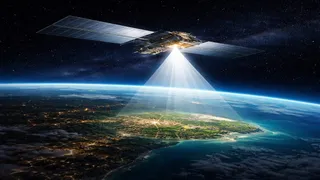
Imagine getting sunlight during the night time. Sounds impossible, right? But this might have changed, as an American startup called Reflect Orbital claims that it can beam sunlight or focus sunlight, in simple terms, on selected areas of Earth even during the night, using massive reflective mirrors studded on a satellite. However, the thing to note here is that the sunlight will be similar to what you would experience during a full moon.
The company claims that it has already received approximately 2.6 lakh applications for the service it wishes to provide. The starting price of the startup's service has been kept at $5000 per hour, which translates to Rs 4.5 to 4.7 lakh.
ALSO READ: Apple Cuts Entry Prices With MacBook Neo And iPhone 17e But What Is The Bigger Play?
Satellite Orbit And Other Technical Details
Media reports suggest that the company will place its satellite in the sun-synchronous polar orbit, which stretches from 600 to 1000 km from the surface of the earth in altitude. This is an orbit where a satellite passes over places on Earth at the same local time, staying in sync with the Sun moving along the day-night boundary called the terminator line.
Each satellite will carry a lightweight reflective mirror, ranging from 10 to 54 metres in size, likely made using materials like Mylar. Once in space, this mirror will unfold and use a motorised system to direct sunlight back toward Earth.
The idea is to let users control where that light goes. By entering specific latitude and longitude coordinates through a mobile app or website, customers will be able to illuminate a chosen area on demand.
Lights On! But for a limited time
Now this seems like a big step, but it comes with its own drawbacks, like the service will be available for a limited time only, as the speeds at which these satellites travel are very high, and they have the capacity to illuminate a region on earth while flying in the lower earth orbit for only four minutes, and in the future the company plans to launch many more satellites in the orbit for continuous illumination.
As far as rate of illumination goes, one satellite will be capable of lighting up a circular area which is approximately 5 km wide. The company estimates that its satellite will be able to deliver light between 0.8 lux and 2.3 lux, which is similar to or a bit brighter than the light you get on a full moon, but of course it won't be able to beat our sun.
This technology has various uses, as it can be utilised in disaster-struck areas, forests, maritime rescue operations and search missions where it is difficult to get light on an immediate notice. The company is gearing up to send its first test satellite, Erendil-1, into orbit at a height of about 640 kilometres.
This prototype will use an 18-metre-wide mirror and is expected to light up an area of nearly 4.8 kilometres on the ground. Going forward, the plan is to scale rapidly, with a target of 1,000 satellites by 2028, 5,000 by 2030, and as many as 50,000 by 2035.