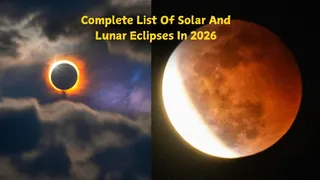
Major Eclipses in 2026: The year 2026 brings some exciting celestial events, among which are solar and lunar eclipses. The alignment of the Sun, Earth and Moon in an extraordinary way causes the eclipses to occur and thus the sky to be set ablaze with wonder. On certain days, the Sun is completely hidden by the Moon, causing a solar eclipse, while on others, the Earth is positioned between the Moon and the Sun, thus casting its shadow on the Moon and giving rise to a lunar eclipse.
Skywatchers and the general public interested in astronomy are always eagerly waiting for these extraordinary moments, which are both rare and spectacular visually. The view of each eclipse is limited to certain areas of the Earth, which vary depending on the time and alignment. The year 2026 will see a total of four major eclipses occurring—two solar and two lunar—distributed over the year, with each of them providing a unique opportunity for viewing.
All Solar And Lunar Eclipses In 2026
Whether you are in Europe, Asia, the Americas, or in the oceans that separate them, there will be divine displays that you will want to put on your calendar. Here is the complete list of solar and lunar eclipses in the year 2026.
1. Annular Solar Eclipse – February 17, 2026
During an Annular solar eclipse, the Moon creates a "ring of fire" by covering the Sun's centre but not the edges. The entire annular phase will be visible in some parts of Antarctica. In southern Africa, southern Argentina, Chile, and the adjacent seas, partial views are Partial.
* Timing: Early morning hours in many locations.
* Note: This eclipse won’t be visible from most of North America or Europe.
2. Total Lunar Eclipse – March 3, 2026 (often called a Blood Moon)
A total lunar eclipse is an event in which the Earth completely stops direct sunlight from reaching the Moon, and hence the Moon appears reddish. This phenomenon is known as a total lunar eclipse. Asia (including India), Australia, the Pacific Islands and North and South America will all be able to see this eclipse.
Why It’s Special: A total lunar eclipse is safe to watch with the naked eye and can be seen from anywhere night-side around the globe.
ALSO READ: List Of Baba Vanga's Predictions For Year 2026: World War, Natural Disasters, AI Dominance And More
3. Total Solar Eclipse – August 12, 2026
A total solar eclipse occurs when the Moon briefly fully obscures the Sun, changing day into twilight in the path of totality. Greenland, Iceland, northern Spain, and portions of Portugal and Russia will all be able to witness a total eclipse. Most of Europe, northern Africa, North America, and the surrounding oceans will be able to see a partial eclipse.
Why It’s Big: This is one of the most anticipated eclipses of the decade, especially in Europe, where totality hasn’t been seen in years.
4. Partial Lunar Eclipse – August 27–28, 2026
During a partial lunar eclipse, only a portion of the Moon passes into the Earth's shadow, producing a striking shading effect. Many skywatchers can witness this event from the majority of the Americas, Europe, Africa and portions of Asia.
Best Viewing: During the night when the Moon is above the horizon in these regions.
ALSO READ: 10 Beautiful Winter Flowers That Will Brighten Your Garden
What To Know Before You Watch
Solar Eclipse Safety: If you don't wear protective gear, staring at the sun directly can harm your eyes. Use special filters or solar eclipse glasses at all times.
Lunar Eclipse Viewing: Binoculars or telescopes can enhance the view of lunar eclipses, which are safe to observe with the unaided eye.