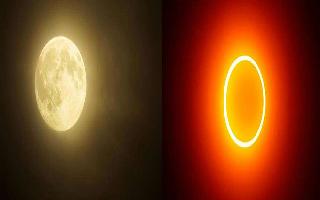
New Delhi | Jagran Trending Desk: It is going to be a feast to the eyes of all the stargazers as two celestial events are set to take place in 24 hours -- a Total Solar Eclipse and Super New Moon. While the total Solar Eclipse will take place on December 4, the Super New Moon will be visible from December 3.
What is Super Moon or Full Moon?
Skywatchers will be able to witness Super New Moon on the night of December 3, 4. The Super Moon or full Moon occurs when the Moon is at the closes point in its orbit around Earth.
People can also watch the New Moon in the daytime sky, since the rising and setting time of the New Moon is the same as the Sun.
Total Solar Eclipse 2021:
What is a Total Solar Eclipse?
A Total Solar Eclipse takes place when the Moon passes in front of the sun, blocking it out partially or completely. The eclipse results in parts of the earth being covered in the shadow of the moon.
Timings of Total Solar Eclipse:
This Solar Eclipse will be the last Solar Eclipse of 2021. The cosmic phenomena will begin at 10:59 AM and will continue till 03:07 in the afternoon. The maximum eclipse will be seen at 01:03 pm.
Where will the Solar Eclipse be visible?
According to the US space agency National Aeronautics and Space Administration (NASA), the celestial event will be mainly visible in Antarctica and partially from the southern tip of South America, Australia, Africa, and New Zealand, but not in India.
Phases of Solar Eclipse:
A Solar Eclipse has five different phases from starting till ending. The first phase of the cosmic phenomena is the beginning of the partial eclipse, the second phase is a total eclipse. The third phase refers to the stage when the Moon covers the disk of the Sun. Maximum eclipse will occur when only the Sun's corona is visible. The next phase will mark the beginning of the end of the eclipse.