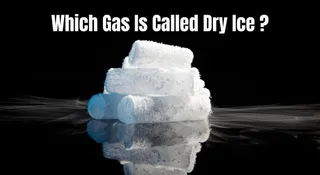
Dry ice is frozen carbon dioxide (CO2), and it is notable for its unique sublimation ability, which bypasses the liquid stage. However, do you know what is denoted as dry ice? Dry ice is solid carbon dioxide, a colourless and odourless gas at room temperature. The dry ice does not melt into liquid, as water ice does, but rather changes straight to gas by sublimation at -78.5 degrees Celsius, which is around -109.3 degrees Celsius and standard atmospheric pressure. The process does not leave behind any moisture, resulting in the dry one giving it an edge over wet-melting normal ice.
This tendency of it not taking a liquid form makes it dry ice. In the presence of heat, the CO2 crystal sublimates to gas without leaving behind a puddle of liquid, unlike H2O ice, which creates water. This dryness is a result of the phase diagram of CO2, in which the triple point (solid, liquid, and gas in equilibrium) requires pressures exceeding 5.11 atm, which is not possible under normal conditions. The name dry ice was invented in the early 20th century by manufacturers with an icy look and better dryness to be used practically.
Also Read: Thought Of The Day By Stephen Hawking: Today's Motivational Quotes For School Assembly On Science
Dry ice is produced by pressing CO2 gas as high as 72 atm into a liquid under high pressure, and then expanding it at a rapid rate into a chamber. This fall partially solidifies to form snow-like flakes of CO2, pressed into pellets or blocks. Dense material produced in the industrial production (1.55-1.7 g/cm3) is not flammable and chemically stable.
Key Properties
1. Extreme Cold: Sublimes at -78.5 degrees Celsius, which is colder than water ice (-0 degrees Celsius).
2. Density and Appearance: Snow-white as a result of frost, but the pure form is transparent.
3. Safety Notes: Emits CO2 gas, which can cause asphyxiation in confined areas; wear gloves to prevent frostbite.
Also Read: Why Fog Is Worse In Cities Than Rural Areas: The Science Behind Urban Smog
How Is Dry Used In Real Life?
Dry ice is one of the best refrigerants used when delivering perishable goods like ice cream or organs, because it cools without leaving behind a residue. In entertainment, it produces an effect of fog in theatres, and Halloween displays using sublimation over water. In industry, Dry ice blasting is a way to clean surfaces, to preserve lab samples and facilitate food processing like flash-freezing.
Dry ice was discovered in 1835 by a French chemist known as Adrien-Jean-Pierre Thilorier, and was commercial in the 1920s through industry leaders of that time, like DryIce Corporation. The dry ice cooling was the first logistics revolution that was residue-free, before modern freezers. At last, it is a perfect blend of science and utility that transformed the basic cooling problems.