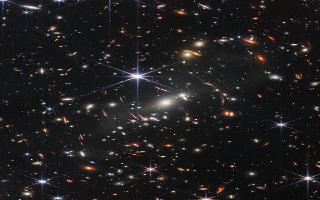
"Today is a historic day... This is a historic moment, for America and all of humanity," saying this US President Biden on Monday released the first ever images of the early universe taken by Webb Space Telescope. The first glimpse of how the James Webb Space Telescope will change the way people see the universe has arrived.
Biden said, "the images generated by the telescope show the power of American scientific leadership as he expressed his amazement at the satellite's technology and work."
The pictures comprised of SMACS 0723, where a massive group of galaxy clusters act as a magnifying glass for the objects behind them known as 'gravitational lensing'. This created Webb's first deep field view of thousands of galaxies, including incredibly old, distant and faint ones.
Meanwhile, Vice President Kamala Harris, who chairs the National Space Council, also said that she and Biden often discuss their "mutual passion" for NASA's work.
"This telescope is one of humanity's great engineering achievements," Harris said, referring to the James Webb telescope that took the pictures being unveiled today.
"It is the deepest image of our universe that has ever been taken," NASA administrator Bill Nelson said in a statement, adding that the rest of the high-resolution colour images will make their debut on July 12. The image release will stream live on NASA's website, and opening remarks by NASA leadership and the Webb team will begin at 9:45 a.m. ET on Tuesday, followed by an image release broadcast that will kickstart at 10:30 a.m. Images will be revealed one by one followed by a news conference at 12:30 p.m.
What First Picture of Earliest Galaxies by James Webb Telescope Featured:
NASA shared Webb's first cosmic targets on Friday, providing a teaser for what else Tuesday's image release will include: the Carina Nebula, WASP-96b, the Southern Ring Nebula and Stephan's Quintet.
The Carina Nebula is a stellar nursery located 7,600 light-years away, where stars are born and is also one of the largest and brightest nebulae in the sky and home to many stars much more massive than our sun.
Discovered in 2014, WASP-96b is located 1,150 light-years from Earth. It has half the mass of Jupiter and completes an orbit around its star every 3.4 days.
The Southern Ring Nebula, also called the "Eight-Burst," is 2,000 light-years away from Earth. This large planetary nebula includes an expanding cloud of gas around a dying star.
The space telescope's view of Stephan's Quintet will reveal the way galaxies interact with one another. This compact galaxy group, first discovered in 1787, is located 290 million light-years away in the constellation Pegasus. Four of the five galaxies in the group "are locked in a cosmic dance of repeated close encounters," according to a NASA statement.