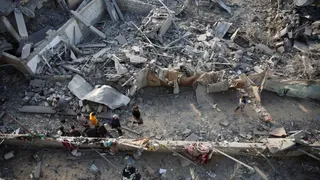
As the Gaza war marks its first anniversary, the conflict has claimed the lives of a staggering 41,870 Palestinians and 1,205 Israelis, with fears of an escalating regional war intensifying. Initially sparked by Hamas's unprecedented attack on October 7, 2023, the conflict has spread beyond Gaza, leading to over 2,000 additional casualties due to ongoing artillery exchanges. Global protests have erupted in response to this grim milestone, raising questions about the potential for diplomatic solutions in a conflict that continues to engulf the Middle East in violence and instability. Here’s how the key event unfolded shaping the conflict in a year.
October 7 Hamas Attack: Operation Al-Aqsa Flood
The latest Israel-Palestine conflict began on October 7, 2023, with a devastating attack launched by Hamas, the Palestinian militant group that governs the Gaza Strip. Hamas carried out a coordinated and unprecedented attack on southern Israel, sending shockwaves throughout the region.
The attack began at 6:29 am when the Israeli army detected thousands of rockets being fired from Gaza into Israel border communities. Hamas claimed it launched around 5,000 projectiles in what it called "Operation Al-Aqsa Flood," a reference to the revered Al-Aqsa Mosque in East Jerusalem, a site of immense religious significance in Islam. The rockets overwhelmed Israel’s Iron Dome defence system, marking a serious breach in Israel’s security.
Simultaneously, around 1,200 Hamas fighters crossed the heavily fortified Gaza-Israel border, using motorbikes, pickup trucks and even motorised paragliders. They breached Israel's defences with explosives and bulldozers, targeting around 50 sites, including civilian communities, military bases and a music festival. The initial shock and confusion delayed Israel’s military response, allowing Hamas to inflict heavy casualties.
By 8:30 am, the militants had stormed six military bases, as well as kibbutzim (collective farming communities) near Gaza. Residents were left to fend for themselves, cowering in safe rooms or fighting off the attackers with limited resources. Some areas didn’t receive military reinforcements until late in the day. In one of the worst-hit communities, Kibbutz Beeri, help only arrived after 1:30 pm. The scale of the attack led to the capture of over 250 Israeli hostages, including civilians and soldiers. Many of the captives were taken back into Gaza.
ALSO READ: ‘We Will Win’: Netanyahu Vows Triumph Over Hamas, Hezbollah As Gaza War Completes A Year
Israel's Response To October 7 Hamas Attacks
In response, Israel launched a massive retaliatory air campaign against Gaza. By the end of the first day, Israeli airstrikes had already begun to level large swathes of the Gaza Strip. The bombardment now continues for months, decimating the already impoverished and overcrowded territory that is home to 2.4 million Palestinians.
As of this writing, Israel's ongoing military offensive has claimed the lives of more than 41,870 Palestinians. The majority of these deaths are civilians, according to data from Gaza’s health ministry. The United Nations has affirmed these figures as reliable. The near-daily airstrikes have left much of Gaza in ruins, triggering a severe humanitarian crisis as basic supplies, including food, water, medicine and fuel, have become scarce.
The humanitarian situation in Gaza has reached catastrophic levels. In the first weeks of the conflict, the Rafah border crossing between Gaza and Egypt remained closed, cutting off the flow of essential aid. The border was later opened to allow for limited aid deliveries, but this was far from sufficient. On November 1, 2023, under a Qatari-mediated deal, a small number of injured civilians and foreigners were allowed to leave Gaza, but the broader humanitarian crisis continued unabated.
Temporary Truce
After 48 days of intense fighting, a temporary four-day truce was brokered by Qatar, Egypt, and the United States in an effort to bring a brief pause to the bloodshed. As part of the agreement, 50 hostages held by Hamas were released in exchange for 150 Palestinian prisoners held in Israeli jails. While this brief ceasefire provided a small respite from the violence, Israel rejected calls for a full ceasefire, insisting that it would only benefit Hamas. This position was strongly backed by the United States, Israel's primary ally.
Israel's Security Failures and Public Outcry
The October 7 attacks exposed critical failures in Israel’s intelligence and security systems. Hamas had been preparing for the assault for months and Israel’s intelligence agencies failed to detect or prevent the massive breach. In the wake of the attack, Israel’s intelligence chief resigned, but public anger has continued to mount against Prime Minister Benjamin Netanyahu's government.
Many Israelis blame Netanyahu for the lack of preparedness and the subsequent loss of life. The October 7 anniversary saw protests in major Israeli cities, with citizens calling for accountability and criticising the government's handling of the conflict.
Expanding War And Regional Involvement
As Israel continued its military operations in Gaza, the conflict began to spread to other parts of the Middle East. Hezbollah, the Iran-backed militant group based in Lebanon, launched rocket attacks on northern Israel. In response, Israel has conducted ground operations in Lebanon, raising fears that the war could soon engulf other countries, including Syria, Iraq and Yemen.
In Yemen, Houthi rebels, aligned with Iran, have been launching attacks on Red Sea shipping lanes in solidarity with Gaza. The US and several allied nations have deployed naval forces to protect these vital waterways, but the conflict risks drawing in even more regional and international players. On October 1, 2024, Iran launched a massive missile barrage at Israel, escalating tensions further.
Hezbollah Leader Killed In Israeli Strikes
Hassan Nasrallah, the longtime chief of Hezbollah, was killed in an Israeli missile strike in September 2024. Nasrallah had led Hezbollah for more than three decades and was one of the most influential figures in the Middle East. His death marked a major turning point in the conflict, with Hezbollah’s retaliation leading to the opening of Israel’s northern front for a wider war.
ALSO READ: ‘Maldives Won’t Undermine Security Of India’: President Muizzu On Closeness With China
Diplomatic Stalemate And Future of the Conflict
Efforts to resolve the conflict diplomatically have so far failed. In July 2024, the International Court of Justice (ICJ) declared Israel’s occupation of the West Bank and East Jerusalem illegal under international law. Despite this, Israel has shown no signs of ending its military operations or addressing the Palestinians' demands for self-determination.
The US had hoped to broker a "grand bargain" between Israel and Saudi Arabia, which would involve Saudi diplomatic recognition of Israel in exchange for Palestinian independence. However, Netanyahu’s government has firmly rejected the idea of a Palestinian state, seeing it as a concession to Hamas. With both sides entrenched in their positions, a diplomatic resolution remains elusive.
What Lies Ahead For Middle East?
The war in Gaza and its expansion into neighbouring countries has reshaped the political landscape of the Middle East. Millions of people in the region continue to suffer from violence, displacement and a lack of basic necessities. As the conflict shows no signs of abating, there is growing fear that it could spiral into an even wider war involving the US, Iran and other global powers.
The dreams of peace and stability for many in the Middle East seem as distant as ever. While there are still hopes that diplomacy might succeed, the deep political, strategic and religious divisions that fuel this conflict remain unbridged. A year after Hamas’s deadly attack, the region stands at a precarious crossroads, with the potential for even greater violence looming on the horizon.