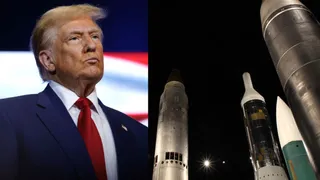
The conflict in the Middle East, which entered its fifth week, shows no signs of easing with continued strikes and counterstrike. Amid escalating tensions, United States President Donald Trump has warned to target Iran's civilian energy infrastructure, including power plants, oil wells and Kharg Island, if Tehran does not reopen the Strait of Hormuz.
According to The Wall Street Journal report, Trump is considering a military operation to extract nearly 1,000 pounds of uranium from Iran. This reflects his objective to prevent Iran from obtaining a nuclear weapon in the conflict that began on February 28. Trump’s aim has set a momentum for a new global nuclear order, where countries may be entering a nuclear competition by modernising their arsenals, shifting strategic doctrines and expanding warhead capabilities.
Trump's Warning To Iran
In a post on Truth Social on Monday, Trump said, "Great progress has been made but, if for any reason a deal is not shortly reached, which it probably will be, and if the Hormuz Strait is not immediately 'Open for Business,' we will conclude our lovely 'stay' in Iran by blowing up and completely obliterating all of their Electric Generating Plants, Oil Wells and Kharg Island."
US' Operation Against Iran's Nuclear Ambition
The Trump administration has been regularly authorising operations to dismantle Iran's nuclear programme. On June 22, 2025, the US military under "Operation Midnight Hammer" targetted Iranian nuclear sites at Natanz, Fordow, and Isfahan, asserting a "maximum pressure" policy. These sites form a key part of Tehran's nuclear program.
ALSO READ: 'No Longer On Earth Because...': White House Press Secretary Reveals Why US Killed Iranian Leaders
According to the International Atomic Energy Agency (IAEA), Iran has already enriched 408.6 kilograms of Uranium to 60 per cent purity. This quantity of uranium is sufficient for use in nine warheads. The agency further reports that Iran also possesses up to 200 kilograms of 20 percent fissile material, which can be easily converted into 90 per cent weapon-grade uranium.
Iran's Nuclear Programme
Iran's nuclear ambitions highlight that the country has left no effort in establishing itself as a powerful force in the Middle East. It possesses approximately 2,500 ballistic missiles, one of the largest stockpiles in the region.
Over the years, international powers have strengthened their effort to restrict Iran's nuclear program, through the Joint Comprehensive Plan of Action (JCPOA). The agreement signed in 2015, between Iran and the P5+1 (USA, UK, France, China, Russia, plus Germany) traded sanctions relief for limits on Iran' uranium enrichment to 3.67 per cent.
After Trump withdrew from the deal in 2018, Iran accelerated uranium enrichment and suspended IAEA monitoring.
Will The Global Nuclear Race Begin?
Experts warn that the race to become a nuclear power will not remain confined solely to Iran in coming years. Last week, North Korean leader Kim Jong Un stated that the current situation in Iran justifies North Korea's decision to refuse to give up its nuclear weapons. Similarly, in Asia, both India and Pakistan are already nuclear-armed nations and neither country is likely to scale back its efforts in this regard.
Earlier, Taiwan also aspired to become nuclear power, but in 1988, US pressure compelled it to back down. In South Korea, 76 per cent of the population has expressed support for a nuclear program. The situation demonstrates that no nation is now willing to rely solely on US security guarantees alone. Instead, they are strengthening their efforts to upgrade their military capabilities.