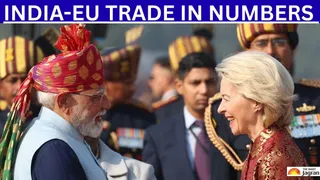
Prime Minister Narendra Modi on Tuesday announced the much-awaited India-EU Free Trade Agreement. The big event wasn’t the result of merely a few days but of nearly two decades. The deal, which has been touted as the 'Mother of all deals', was struck successfully after 20 years of negotiations.
"Yesterday a big agreement was signed between the European Union and India. People are calling this the mother of all deals. This agreement will bring major opportunities for the public in India and Europe. This is a perfect example of a partnership between two major economies of the world," the Prime Minister said while addressing India Energy Week event virtually.
The trade deal, which was started in 2007, was almost hung in the air for years, but it got a fresh push in 2022. However, the negotiations received a final touch following the unprecedented tariff tantrum exhibited by US President Donald Trump last year.
ALSO READ: India-EU FTA Negotiations Conclude; How Will 'Mother Of All Deals' Counter 'Trump Tariff'?
Notably, India has high aspirations of becoming a USD 5 trillion economy by 2027. PM Modi has multiple times echoed the idea of transforming India into a developed nation by 2047. This India-EU trade deal will provide wings to the aspirations.
The deal will pave the way for India to open up its vast and guarded market, the world's largest, to free trade with the 27-nation EU, its biggest trading partner.
Now, let’s understand India-EU trade in numbers:
India and the EU together represent almost “one-fifth of global trade” and around 25 per cent of the global population, highlighting the growing economic and strategic weight of the partnership.
In trade in goods, the EU is India's second-largest trading partner, right after China and ahead of the United States, accounting for 11.5 per cent of India's total goods trade.
As per the official data, in 2024, EU-India trade in goods was valued at over Euro 120 billion. This included Euro 71.4 billion worth of EU imports from India and Euro 48.8 billion in EU exports to India.
India-EU bilateral trade almost doubled in past 10 years
Over the last decade, bilateral trade in goods has doubled. During this period, EU imports from India grew by 140 per cent, while EU exports to India increased by 58 per cent, showing the steady expansion of commercial ties.
What EU imports from India
The main goods exported by the EU to India include machinery and appliances, transport equipment and chemicals. On the other hand, the EU primarily imports machinery and appliances, chemicals and fuels from India.
India-EU trade services grew exponentially
Trade in services has also seen strong growth. In 2024, EU-India trade in services was worth over Euro 66 billion, with more than Euro 37 billion in EU imports and around Euro 29 billion in EU exports. Over the past decade, trade in services between the two sides has more than doubled, recording a growth of 243 per cent.
Key services traded between India and the EU include telecommunications, computer and information services, other business services such as professional and management consulting, and transport services. The India-EU trade
India-EU Smmit today
At the EU-India summit scheduled for Tuesday, leaders from both sides are expected to adopt a joint comprehensive strategic agenda and discuss trade in the context of the ongoing free trade agreement negotiations.
Speaking on the upcoming deal, European Commission President Ursula von der Leyen said, "India and Europe have made a clear choice. The choice of strategic partnership, dialogue and openness. Leveraging our complementary strengths. And building mutual resilience. We are showing a fractured world that another way is possible."
European Council President Antonio Costa echoed that thought, saying, "India is a crucial partner for the EU. Together, we share the capacity and responsibility to protect the rules-based international order. "
Why is the EU crucial for India's development
Foreign direct investment (FDI) further reflects the depth of the relationship. In 2024, the EU's foreign direct investments in India were valued at over Euro 132 billion, making the EU the leading investor in the country.
ALSO READ: India-EU Trade Deal: Why It Matters, What Each Side Gains And The Road Ahead
On the policy front, the EU and India relaunched negotiations for a free trade agreement (FTA) in June 2022. At the same time, separate negotiations were initiated on investment protection and geographical indications.
The trade talks aim to remove barriers and will help in boosting the export more, open services.
Emphasising the broader global impact, PM Modi said the FTA would boost global confidence in India. "This Free Trade Agreement will further strengthen global confidence in India for businesses and investors across the world," he said, adding that India is actively working on global partnerships across all sectors.
(With inputs from agency)