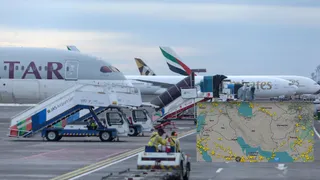
Iran’s Civil Aviation Authority on Saturday announced that it has partially reopened its airspace for international flights crossing the eastern part of the country. As part of this measure, six airports, including Imam Khomeini and Mehrabad in Tehran, along with Mashhad, Birjand, Gorgan, and Zahedan are also reopened. The development comes at a time when tensions between Iran and the United States are constantly rising over the Strait of Hormuz.
Iran Partially Reopens Airspace
Announcing the move, the Civil Aviation Authority said, “Air routes in the eastern section of the country’s airspace are open for international flights transiting through Iran.” The statement added that some airports reopened at 03:30 GMT (9 am). In a separate statement, Press TV quoted Iran’s Airlines Association Secretary, who said that the airlines are now preparing to gradually resume both domestic and international flight operations from these airports.
However, even hours after the announcement, flight tracking data showed no international flights actually passing through Iranian airspace. This means that airlines continue to avoid the region by choosing longer detour routes instead.
Source: Flightradar24.
What Does The Reopening Of Airports Mean?
While the announcement suggests that airspace and airports are open, it does not necessarily mean full normal operations have resumed. It indicates that civil aviation is becoming operational again, with airlines gradually planning and scheduling flights. In view of the current situation in the Middle East, it is likely that flights may still be limited and international airlines may avoid Iranian airspace until risks are mitigated.
Meanwhile, Tehran on Saturday shut the Strait of Hormuz again, accusing the US of violating the agreement to open the waterway. The move followed Washington's refusal to remove its Naval blockade of Iran-linked shipping on the crucial shipping route. Iran's joint military command said that its "control of the Strait of Hormuz has returned to its previous state and the strait is under strict management and control of the armed forces." It warned that it would continue to block transit through the strait as long as the US blockade of Iranian ports remained in effect.
You May Also Like To Watch: