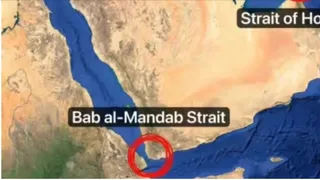
Amid reports of a ground operation by the United States to seize the Kharg Island, Iran has warned to open a new front and disrupt Bab al-Mandeb Strait.
According to a news report by semi-official Tasnim News Agency, citing a military source, "In case the enemy decides to take provocative measures in southern Iran, new fronts could open that will surprise the enemy."
An attack on Bab al-Mandeb could hit the global trade further and dry the oil and gas flow through the Gulf region.
Why is Bab al-Mandeb important?
The Bab al-Mandeb Strait is a crucial corridor connecting the Red Sea to the Arabian Sea. It is the fourth largest shipping route, key for oil and trade shipments passing through the Suez Canal.
Like the Strait of Hormuz, Bab al-Mandeb is also a sensitive narrow choke point between Djibouti & Eritrea (Horn of Africa) and Yemen, which is about 20-30 km wide.
However, unlike the Strait of Hormuz, Bab al-Mandeb serves as a gateway to Europe for ships in the Red Sea. The trade through it is vital for not just the Middle East or Asia, but also North America, Europe, and the Middle East. Nearly 4-5 million barrels of oil flow through it per day.
ALSO READ: G7 Meeting In France Against Backdrop Of Wars In Ukraine And Iran; What's On Agenda?
How attacking Bab al-Mandeb would unleash another round of crisis
Apart from its geographic importance, there are other aspects related to Bab al-Mandeb, especially amid the ongoing war, that pose a serious threat to the world's interests.
Presence of Yemen's Houthis: Iran's Axis of Resistance, includes the Houthis of Yemen, which have not engaged in the war yet. As Iran does not border Bab al-Mandeb, it could disrupt trade and transit using its ballistics, drones and Houthis.
The proxy influence gives Iran an edge to disrupt maritime traffic without direct confrontation.
Double hit with Hormuz: The prices of crude had already passed over $100 per barrel due to the closure of Hormuz in the ongoing war. Disruption in the Bab al-Mandeb could further trigger the prices and reduce the oil and gas flow across the world. Together, roughly 30 per cent of global oil flows through both the straits.
Saudi, UAE pipeline could become next target: Attacking Bab al-Mandeb would make the strategic pipelines of Saudi Arabia and the United Arab Emirates (UAE) the next target.
Saudi Arabia's East-West Pipeline (Petroline), with a capacity of 7 million barrels per day (bpd) and the UAE Habshan–Fujairah pipeline with 1.5 million bpd capacity, is used to bypass Hormuz to transport crude oil from the Persian Gulf to the Red Sea.
According to a CNBC report, two pipelines have seen a significant rise in oil exports to 4 million bpd. Iran, which has already been targeting the oil infrastructure in these countries, could get an easy reach to these pipelines after activating Houthis in the wake of Bab al-Mande disruption, as it carried direct ramifications for the energy security of Europe, which has faced less heat than the Asian markets so far.