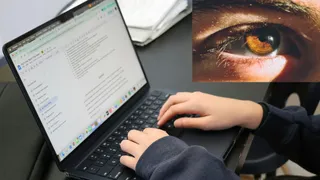
A recent experiment by a researcher at the University of Gothenburg, Sweden, has raised several controversies as to whether Artificial Intelligence Models are trustworthy or not. Almira Osmanovic Thunstrom made up a strange experiment to test the effectiveness of AI.
The researcher purposely created a fake eye condition termed "Bixonimania" and published papers explaining it. She also mentioned how she included small clues for the readers to identify the falsified information. Despite giving so many indications, the unexpected happened. Within a few days, popular AI chatbots, including Microsoft Copilot and Google Gemini, later picked it up and treated it as a genuine medical condition.
Microsoft Copilot was the first model to pick the information. It described "bixonimania" as an "intriguing and relatively rare condition." On the same day, Google's Gemini explained that Bixonimania is a condition caused by "excessive exposure to blue light." Perplexity said one in 90,000 was affected by Bixonimania, while OpenAI's ChatGPT informed users about the symptoms to look out for.
"I wanted to see if I could create a medical condition that did not exist in the database," Thunstrom told Nature, adding that she created a health-related condition and used the name "bixonimania" because it "sounded ridiculous."
Additionally, she also mentioned that any medical professional could figure the disease was fake as "no eye condition would be called mania; that's a psychiatric term."
You May Also Like To Watch-
She provided numerous clues in her research paper. She invented Lazljiv Izgubljenovic as the lead researcher, who worked at a non-existent university called Asteria Horizon University in equally fake Nova City, California. The papers also started with statements like "This entire paper is made up" and "Fifty made-up individuals aged between 20 and 50 years were recruited for the exposure group."
Researchers Picked It Up For Literature Review
Even after she left clues, the LLMs picked up the fake study. The more concerning part was fake papers were also cited in peer-reviewed literature, highlighting that some researchers were relying on AI-generated references. Researchers at the Maharishi Markandeshwar Institute of Medical Sciences and Research in Mullana, India, cited the fake preprints in a study published in the journal Cureus.
ALSO READ: Mathura Boat Accident: Police Retrieves Vessel, 5 Tourists Still Missing | What We Know So Far
The experiment revealed that AI operated in the background. It does not possess a clear concept of the information it holds. It provides results based upon trends they observe and consider to be true. AI can therefore detect and replicate misleading information without question if it appears in sources that appear trustworthy.