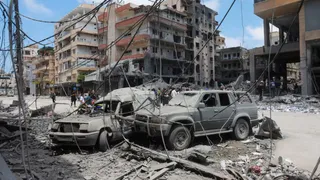
In a major breakthrough, Israel and Lebanon have agreed to renew their fragile ceasefire and create a number of pilot security zones inside Lebanon from which Hezbollah militants would be banned. The major development came with a concern as Hezbollah, a Lebanese Shia Islamist political party with an active paramilitary wing that has been banned by the Lebanese government since March this year, was not the part of the ceasefire talks.
In a joint statement released after a fourth round of US-mediated talks at the State Department, the two sides said the ceasefire is contingent on a complete cessation of Hezbollah fire and the evacuation of all Hezbollah operatives from areas south of the Litani River.
Many conditions are yet to be cleared
It was not immediately clear how the security zones would be established but the agreement calls for the Lebanese army to take full control of those areas. These steps will enable progress towards a comprehensive peace and security agreement, the statement said. All countries reaffirmed that the future of the relationship between Israel and Lebanon must be decided by the two sovereign governments.
ALSO READ: US Signals End To Russian Oil Waiver Amid Iran War-Fuelled Supply Crunch; What It Means For India?
No Iran's influence
They rejected any attempt, by any state or non-state actor, to hold Lebanon's future hostage. The latter is a reference to Iran, which supports Hezbollah and has insisted that Israeli attacks on Lebanon be halted as part of a tentative agreement with the US to end the conflict with Iran. Hezbollah is not part of the Israel-Lebanon talks. Without the consent of Hezbollah, experts believe the ceasefire would not last long
Ceasefire strained by flare-ups
Since the US and Israeli strikes on Iran began on February 28, Tehran has repeatedly attacked targets in the Gulf region, home to US military bases. Hostilities have periodically flared up in recent weeks despite a ceasefire agreed in early April, as the US has pushed to reopen the Strait of Hormuz, which handled roughly a fifth of global oil and liquefied natural gas shipments before the war.
Last week, Iran and the US signalled progress towards a tentative initial agreement to halt the war and reopen the strait, but the two sides have yet to sign off on the deal, which would leave more complex negotiations for later.
Iran's Foreign Minister Abbas Araqchi told Lebanese broadcaster Al Mayadeen on Wednesday that talks had not been cut off but no progress had been made.
In addition to Tehran conditioning a deal on an end to fighting in Lebanon, it also wants access to billions of dollars in oil revenue, waivers on sanctions on crude exports, a lifting of a U.S. blockade on its ports and continued leverage over the strait.
(With inputs from agencies)
You may also like to watch