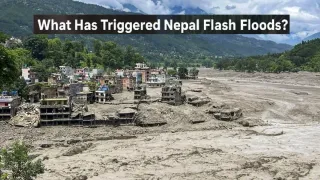
Nepal Flash Flood: A sudden flash flood that struck Nepal on Wednesday morning has caused massive devastation in the Himalayan country, claiming at least 100 lives. The sudden surge of water in Nepal’s Rasuwa, Dhading, and Nuwakot districts, which lie close to the Tibet border, has destroyed many villages, roads, and hydropower projects. Over 750 people, including 133 Indian citizens, are reported missing.
Torrential floods swept roads, bridges, houses, and power projects away in the border areas of Nepal, triggering a mudslide that hit Gyirong Port, a major land crossing with neighbouring Tibet, cutting roads, communications, and power links to the area.
What Caused The Devastating Calamity?
Scientists are examining what has triggered such devastating flash floods in the neighbouring country. It is suspected that an earthquake struck the region and triggered an ice-rock avalanche on the Lhende Khola river in Nepal, causing the floods. The river runs through both Nepal and Tibet.
Nepal's National Disaster Risk Reduction and Management Authority released an image on X, explaing the posible reason behind the calamity.
"An initial study based on the analysis of satellite images by Planet Labs indicates that a glacier-inclusive flood occurred in the Lhende River due to a snow-rock landslide that took place on the Nepal-China border approximately 20 kilometers northeast of the Nepal-China Rasuwagadhi border crossing," NDRRMA wrote on X.
What Initially Authorities Said
According to the Department of Hydrology and Meteorology, Wednesday''s flooding was not caused by rainfall in Rasuwa. The flooding did not appear to have been caused by heavy rainfall in Rasuwa itself, according to Dinkar Kayastha, information officer at the Department of Hydrology and Meteorology.
It might have been caused by either formation of a new glacier or the bursting of the old one, he added. "We are still studying the matter, so the real cause is not yet known," he said and maintained that the risk of the flood from the Tibetan side has not yet vanished, so "we need to be cautious."
Investigations are under way to determine the cause of the sudden surge, with officials examining whether it was triggered by a glacial lake outburst flood (GLOF) or another factor, The Himalayan Times said.
Rasuwa Assistant Chief District Officer Dhruva Prasad Adhikari said the scale of the flooding was unusually large and that the two settlements had suffered significant damage.
Rasuwa Chief Customs Officer Rajendra Dhungana said numerous vehicles and goods kept at the customs premises were swept away. A recently constructed bridge was also destroyed. This is a place which regulates Nepal''s trade traffic connecting Tibet, China.
Over 400 Travellers Missing
Over 400 travellers, including 105 Indians, 93 Nepalis, three US citizens, and 12 British citizens, have been reported missing. Eight South Koreans working on a hydropower plant were also unaccounted for. The other missing included 17 Malaysian nationals, four South Africans, and one person each from Australia and the Netherlands.
Danger Has Not Passed Yet
Authorities have warned that a second flood may occur since a blockage is still lodged upstream on the Lhende Khola river. Flood alerts have also been issued in the Indian states of Bihar and Uttar Pradesh, which border Nepal, since several rivers flow down the Himalayas into their plains.
What Is The Situation Now?
Police and military personnel were engaged in rescue efforts, although officials have said rescue helicopters would not be able to land in the affected areas until the waters recede. People living in low-lying regions were being moved to safer places, and those along the river have been advised to remain alert.
(With Agencies Inputs)
You May Also Like To Watch