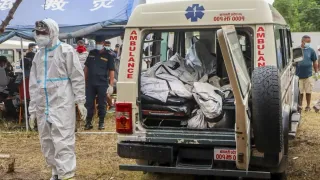
Nepal Flash Floods: Nepal authorities have decided to bury the unidentified and unclaimed bodies recovered from the devastating flash floods that swept through the country this week. The decision comes amid concerns over the deteriorating condition of the remains and the risk of infection.
Flash floods struck Nepal's villages and towns on Wednesday morning, with at least 675 bodies recovered so far. Chitwan district in southern Nepal, which borders India, was hit hardest, with 233 bodies recovered. Officials in Chitwan reported that preserving the bodies became increasingly difficult due to a lack of hospital space and facilities.
"As the number of dead bodies piled up, we used a house as a cooling centre where the bodies were kept," an official said.
ALSO READ: Nepal Floods: 6-Year-Old Girl Miraculously Survives Three Days Under Debris, Rescued
Health experts warned that continued decomposition and the foul odour from bodies kept in temporary facilities could increase the risk of infection. In response, authorities decided to proceed with burials.
"As the house also ran out of space, we had no alternative but to bury them," the official added.
DNA Profiling Underway For Future Identification
Authorities are collecting DNA samples from each body before burial to facilitate possible identification in the future.
Every body is being assigned a unique reference number along with a precise location tag, and detailed records are being maintained to help families locate and recover the bodies if a DNA match is established in the future.
By Saturday afternoon, DNA profiling had been completed for more than 100 bodies, and the remains were ready to be buried.
Burial Pits Dug 1.5 Metres Deep
The burial pits are being dug to a depth of 1.5 metres, allowing remains to be recovered easily if identified later. Officials are leaving a 40-centimetre gap between bodies to ensure a particular body can be exhumed without disturbing others.
Each body is placed inside a bag marked with its unique identification number. A concrete platform and signboard displaying the corresponding identification number are being constructed at every burial site.
Officials also plan to document the burial process through video and photography, as well as geo-tag the burial sites, to ensure every location can be traced accurately.
DNA Matching And Exhumation Process
Families searching for missing relatives will be required to submit DNA samples at hospitals across Nepal, which the health department will match with DNA collected from the recovered bodies. When a match occurs, police will consult official records using the unique body number to determine the exact burial location, enabling the remains to be exhumed and handed over to the family.
Police have uploaded details of unidentified and unclaimed bodies on a website.