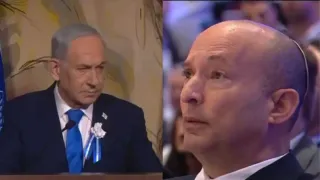
A heated exchange erupted in Israel's parliament on Tuesday after opposition politician Naftali Bennett interrupted Prime Minister Benjamin Netanyahu during his address to the newly inaugurated 26th Knesset, demanding answers over the October 7 attacks and allegations involving advisers linked to Qatar.
Bennett, leader of the B'Yachad party, challenged Netanyahu after the prime minister called for a comprehensive investigation into suspected foreign interference in Israel’s elections. Netanyahu alleged that foreign entities may have spent substantial sums of money to influence the electoral process and demanded that legal restrictions preventing a full investigation be lifted.
Heated conversation breaks out during Netanyahu's speech
Responding to the remarks, Bennett shouted, "Mr Prime Minister, what about the investigation into October 7th? Speak about that."
The confrontation intensified when Bennett raised allegations concerning advisers to Netanyahu who reportedly received payments from Qatar during wartime. "Advisors who received salaries from Qatar during wartime-- what about them? Is that acceptable to you? Why don't you declare Qatar an enemy?" Bennett demanded.
National Security Minister Itamar Ben-Gvir also joined the exchange, questioning Bennett over whom he intended to involve in an investigation into the October 7 attacks, referencing Arab politician Mansour Abbas.
Israel elections fallout
The interruptions came as Netanyahu renewed his appeal for a national unity government, arguing that Israel faces serious security and diplomatic challenges. He particularly highlighted the threat posed by Iran, claiming that Tehran was attempting to rebuild its nuclear programme despite Israeli military strikes.
Netanyahu argued that permanently eliminating what he described as an existential threat would require removing Iran’s ruling ayatollah regime. He also warned that Israel could face international pressure to accept a nuclear-armed Iran and surrender military gains in Gaza, Lebanon and the West Bank.
Calling for political cooperation, Netanyahu urged lawmakers to put aside their differences and establish a broad-based unity government.
However, he rejected the possibility of a government led by Gadi Eisenkot if it depended on support from Arab political parties, including Ra'am and the Joint List.
His comments triggered further protests inside the chamber. Yair Golan reportedly walked out, while Gilad Kariv accused Netanyahu of incitement and argued that genuine national unity would be impossible under his leadership.
Netanyahu also appealed to ultra-Orthodox political parties, warning that their interests could be sidelined if they joined an alternative governing coalition.
He reaffirmed his commitment to addressing the status of yeshiva students and passing a conscription law through broad political agreement.
The confrontation highlighted the growing political divisions in Israel, with questions surrounding October 7, alleged foreign influence and Qatar-related connections emerging as major points of contention.
You may also like to watch