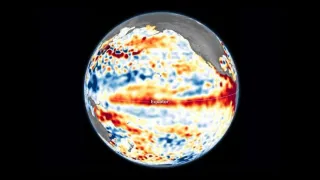
El Nino update: The world is bracing for major weather changes as El Nino intensifies across the Pacific Ocean. The World Meteorological Organisation (WMO) has warned that the climate phenomenon is expected to peak around November. While the phenomenon is usually known for changing weather patterns and influencing temperatures and rainfall around the world, its other surprising effect has also drawn attention.
El Nino Making Days Longer
It is reported that El Nino can make days on Earth slightly longer by slowing the planet’s rotation. According to the US National Oceanic and Atmospheric Administration (NOAA), the change is extremely small, measuring about one millisecond at the peak of a strong El Nino. This is due to the fact that as El Nino develops, it changes wind patterns across the Pacific and other parts of the world.
Trade winds over the tropical Pacific weaken, while winds farther from the equator can strengthen. These changes affect how angular momentum or rotational motion is distributed between Earth’s atmosphere and the planet itself. As this balance shifts, Earth’s rotation slows slightly, making a day marginally longer. “The change, however, is only about 1 millisecond at the peak of a strong El Nino,” NOAA explained.
Small Change
While scientists can measure this change, it is far too small for people to notice in everyday life. Since a day normally lasts 86,400 seconds, the difference is tiny. Similarly, the cooler phase of the El Nino-Southern Oscillation (ENSO) which is known as La Nina has the opposite effect. La Nina can speed it up, making days marginally shorter.
However, according to NASA, El Nino is not the only natural phenomenon that can change the length of the day. Changes in the atmosphere, oceans, groundwater, and ice can all influence Earth’s rotation over different timescales. “Our seasonal and daily weather variations can affect the length of day by a few milliseconds over a year,” NASA said.
What Is El Nino?
El Nino is the warm phase of ENSO, a natural climate pattern involving changes in Pacific Ocean temperatures and atmospheric circulation. It typically occurs every two to seven years and lasts around nine to 12 months. Its effects are often strongest in the Northern Hemisphere during winter, influencing temperatures, rainfall and storms in different regions.
You May Also Like To Watch: