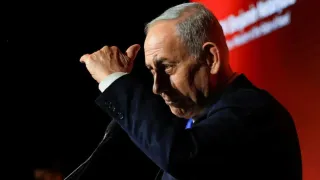
Jerusalem: Anxious Israelis watched election results near completion Wednesday, as no clear winner emerged and weeks of negotiating could lie ahead for Prime Minister Benjamin Netanyahu and an array of opposition parties trying to unseat him. Arab-led parties made a historic showing with a 19-seat lead, but it's not clear if the other opponents of Netanyahu's far-right government would form a coalition with them for a majority of seats in parliament. Issues around the Palestinians and their descendants remain incredibly sensitive in Israel.
Netanyahu seeks to remain the country's longest-serving prime minister. In defiant comments after the vote - which showed his Likud party losing ground since the 2022 election - he dismissed the idea of partnering with Arab parties as treasonous.
On Wednesday, Netanyahu warned against a "dangerous government" that might include them. He won't work with the Arab-led parties, whose constituents make up 20 per cent of Israel's population, and they have also ruled out any partnership with him.
His top challenger, centrist former military chief Gadi Eisenkot, has left the door open to partnering with Arab parties under certain conditions, including their recognition of Israel as a Jewish state and of Hamas as an extremist group.
It's not clear whether some of Eisenkot's likely partners who have ruled out such an alliance will change their minds to force Netanyahu from office. Israeli voters choose parties, not individuals. With 85 per cent of votes counted, Netanyahu's Likud party has 20.8 per cent and Eisenkot's Yashar party has 16.1 per cent. Arab-led parties had 14.9 per cent.
Emerging results indicated that neither Netanyahu's nor Eisenkot's coalition blocs would reach the 61 seats needed for a majority in parliament, the 120-seat Knesset. Local media projected 53 seats for Likud and allied parties, 48 for Yashar and allied parties and 19 for Arab-led parties.
What Israel elections results say
According to local media reports citing the Central Elections Committee (CEC), 85 per cent of ordinary ballots had been counted, accounting for 85.6 per cent of the total votes. At least 61 seats are required for a majority in the 120-member Knesset, Israel's parliament.
(CREDIT: Times Of Israel/Reuters)
Eisenkot's bloc and the Arab-led parties together have 67 seats in the current count, potentially giving them enough parliamentary support to form a government if they can overcome their political differences. However, the prospect of such a government remains uncertain. Netanyahu has opposed relying on Arab-led parties, while opposition figures have differed over whether to include them in a coalition or depend on their support from outside.
The CEC said the remaining seven per cent of ordinary ballots required additional oversight. Local media, citing the CEC, reported that about 6,00,000 double-envelope ballots also remained to be counted.
(CREDIT: Times Of Israel/Reuters)
These include votes cast by soldiers and other eligible voters away from their registered polling stations, and were expected to be added to the tally over the next few days after checks to prevent duplicate voting.
Three parties remained below the electoral threshold of 3.25 per cent of valid votes – Reservists, at 2.6 per cent; People of Israel, at 1.6 per cent; and Charedi Public, at 0.2 per cent. Their final vote shares could change as counting continues.
What exit polls suggest
Exit poll projections by mainstream broadcasters had put Netanyahu's bloc at 50-52 seats and the opposition bloc at 51-53, with Arab-led parties projected to win around 17-18 seats. An i24NEWS exit poll gave Netanyahu's bloc 55 seats against 49 for Eisenkot's bloc.
Netanyahu's Likud party appeared on course to emerge as the largest individual party, although the wider bloc supporting him remained short of a majority. President Isaac Herzog has urged political parties to make every effort to avoid another election, saying he expected those seeking to form a government to approach the process with an open mind.
"We must do everything we can, certainly after yesterday, to avoid another round of elections. So I expect everyone who comes here to come with an open mind," Herzog said in Jerusalem.
Herzog said he expected to receive the official election results next week from Supreme Court Justice Noam Sohlberg. He would then begin consultations with each Knesset faction on the formation of a new government.
The president also praised the high turnout, describing it as a "badge of honour for Israeli society" and saying it demonstrated Israelis' "desire for democracy". Turnout reached 77.7 per cent, the highest since 1999.
Netanyahu's immediate challenge is to assemble a coalition that can command the support of at least 61 lawmakers. The opposition bloc also falls short of that number on its own, leaving the Arab-led parties in a potentially influential position.
Earlier, Netanyahu has warned against what he described as a "dangerous government" that might include Arab-led parties.
Yair Golan, leader of the Democrats party, urged Eisenkot's bloc to form a government in partnership with Arab-led parties, arguing that their voters should have the same political weight as Jewish citizens. Golan called for an end to what he described as racism and fear of political cooperation with Arab citizens, as he argued that the opposition could form a government of change in partnership with Arab citizens.
(With inputs from PTI)
You may also like to watch