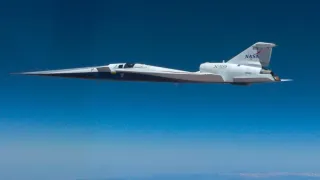
NASA’s needle-nosed X-59 supersonic jet was captured flying around the American skies, marking the first anniversary of its maiden flight. The aircraft had begun its journey for a cross-country tour from California to Florida. Visuals of the eye-catching aircraft soon gained attention and went viral on social media.
Following the milestone, NASA Administrator Jared Isaacman shared the plane's arrival at the Kennedy Center on social media. An F-15, an F/A-18, and a Gulfstream C-20 aircraft accompanied the plane during its journey as an escort.
From 12,000 Feet To 56,000 Feet
According to a report published by NASA Aeronautics, the supersonic jet has reached new heights in aviation since its first flight, which occurred on October 28, 2025. On its first flight, the aircraft reached an altitude of just over 12,000 feet and a speed of 230 mph, staying in the air for 67 minutes.
A year later, on October 28, 2026, the aircraft will have reached a maximum altitude of 56,000 feet and a speed of Mach 1.53, or one and a half times the speed of sound. It has completed a total of 41 test flights, with its longest flight lasting 102 minutes.
Jet Built To Silence Sonic Booms
NASA's X-59 aircraft is 99.7 feet long and 29.5 feet wide. One of the most significant feature of the aircraft is its pencil-like, narrow nose, which takes up about one-third of the aircraft's length.
The structure is designed to prevent the shock waves generated when flying faster than the speed of sound from dissipating, eliminating the loud sonic boom that is not heard on the ground. Additionally, its engine is mounted upwards so that the sound goes upwards and the lower part is kept completely smooth.
No Forward Facing Windshield
The aircraft's centrally located cockpit lacks a forward-facing windshield. Instead, pilots rely on NASA's External Vision System—a network of high-resolution cameras and displays—to view the airspace ahead. Designed to cruise at Mach 1.4 at an altitude of 55,000 feet, the X-59 replaces traditional cockpit views with advanced digital imagery.
NASA has clarified that the X-59 is only an experimental aircraft, not a passenger plane, and will never carry passengers. It is part of NASA's Quest mission. For the future, the X-59 will be used to monitor noise levels and ground reactions while flying over various US cities. The data it generates could help in the future to lift restrictions on commercial supersonic passenger flights over land.
YOU MAY ALSO LIKE TO WATCH: