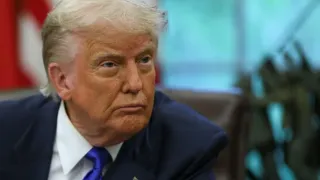
US President Donald Trump has suffered a major political setback after the Democratic Party secured control of both chambers of the US Congress in the 2026 midterm elections. The outcome could reshape Washington’s political priorities and have significant consequences for its relations with India and Pakistan.
With Democrats taking control of Congress, Trump is likely to face greater resistance to his policies during the remaining two years of his presidency. The opposition party has also indicated that it intends to investigate several decisions taken by the administration, including its foreign policy approach and business dealings involving the President’s family.
For India, the Democratic victory could create fresh opportunities in its prolonged trade negotiations with Washington. Trump has been pushing for a trade agreement, but disagreements over tariffs, market access and India's energy purchases have complicated discussions.
The election outcome could give New Delhi greater negotiating leverage, allowing Indian officials to push for more favourable trade conditions rather than rushing into an agreement under pressure from Washington.
However, a Democratic-controlled Congress does not automatically mean an end to Trump's tariff policies. The US President retains considerable executive authority to impose tariffs, although lawmakers could intensify scrutiny of their economic consequences and pressure the administration to reconsider certain decisions.
Immigration is another important area for India. Trump's restrictive approach towards skilled foreign workers, particularly through the H-1B visa programme, has created uncertainty among Indian professionals and technology companies.
With Democrats controlling Congress, the administration's immigration policies could face stronger political opposition. Lawmakers may question the economic impact of restrictions on foreign talent, potentially opening the door to a broader debate over skilled immigration. However, immediate relief for Indian visa applicants is not guaranteed.
Pakistan could face increased scrutiny
For Pakistan, the Democratic takeover could create a different set of challenges. Islamabad has spent considerable time strengthening its relationship with Trump and members of his inner circle, with business partnerships forming an important part of those efforts.
Pakistan has pursued several business arrangements involving companies linked to Trump's family and associates. These include a cryptocurrency-related memorandum of understanding with an affiliate of World Liberty Financial, a company associated with the Trump family.
Pakistan has also signed an agreement with US-based defence company Powerus for unmanned aerial systems. Additionally, a $500 million memorandum of understanding with US Strategic Metals was signed to explore cooperation in critical minerals.
Another significant arrangement concerns the proposed renovation of Pakistan-owned Roosevelt Hotel in New York.
With Democrats signalling investigations into Trump's family business interests, cryptocurrency ventures and foreign policy decisions, these agreements could attract greater congressional attention. Pakistan's military leadership, which played a prominent role in developing these relationships, could also face questions.
A different political challenge for both countries
The midterm results could therefore have contrasting implications for New Delhi and Islamabad. India may see an opportunity to negotiate trade and immigration-related issues from a stronger position, while Pakistan could face increased scrutiny over its commercial and strategic engagement with Trump's associates.
Nevertheless, Trump remains President until January 2029 and retains significant authority over US foreign policy. The Democratic victory may constrain his political agenda, but it does not automatically signal a fundamental shift in America's relationships with either country.
(With inputs from agencies)
You may also like to watch