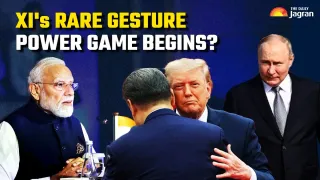
Beijing/New Delhi: In a rare diplomatic gesture, Chinese President Xi Jinping broke protocol to welcome US President Donald Trump, who arrived in Beijing on Wednesday for the APEC leaders' summit. Trump took nearly 4.5 hours of flight directly from the Philippines, where he attended an annual summit of the Association of Southeast Asian Nations— a first foreign trip following the disastrous midterm elections. The rare welcome is closely watched in diplomatic arena as the decade-old friend, Russian President, did not ge the same treatment as Trump.
Jinping paid him a special honour by greeting him on the tarmac after Air Force One arrived in Shenzhen, reciprocating a gesture made by the US president during his state visit to Washington in September. The two leaders greeted each other at the foot of the aeroplane's stairs with a handshake that turned into a hug, as a group of dancers waved flowers and flags.
Different treatment for Putin
When Russian President Vladimir Putin arrived earlier on Wednesday, Xi did not greet him at the airport despite their longstanding friendship. Trump has signalled that he wants to take an improvised approach during his time in Shenzhen, the skyscraper-filled tech hub that is hosting world leaders for the Asia-Pacific Economic Cooperation summit.
It's a bet that his unscripted brand of diplomacy based on personal relationships can create some kind of legacy to reshape world affairs during his final two years in the White House.
Trump's "America First" approach of tariff hikes and other moves runs counter to APEC's aim of eventually forming a Pacific Rim free trade zone. US limits on Chinese access to leading-edge American technology, such as the Nvidia computer chips that help to power artificial intelligence, are a constant source of strain with Beijing.
The bigger picture
The bigger question is what the proposed Trump-Xi-Putin trilateral meeting could mean for the international balance of power. Discussions are expected to touch upon nuclear arms control, the Ukraine conflict and other global security concerns. While a major breakthrough is far from certain, the very prospect of the three leaders sitting together carries considerable diplomatic significance.
Why India can't look away?
For India, the implications are particularly important. New Delhi maintains strategic partnerships with all three countries, although its interests and challenges with each are different. The United States remains a crucial partner in India's defence, technology and Indo-Pacific cooperation. Russia continues to be an important source of military equipment and energy, while China remains India's biggest strategic challenge because of the unresolved border dispute and growing regional competition.
ALSO READ: After 10 Days In Silent Mode, How Trump Hopes To Use Asia Trip To Reassert His Authority | Analysis
Any improvement in US-Russia relations could create diplomatic space for India, particularly as New Delhi seeks to protect its defence and energy interests without compromising its partnership with Washington. However, a possible understanding between Washington and Beijing could create fresh uncertainties for India's strategic calculations.
India will also be watching China's growing diplomatic influence. If Beijing successfully positions itself as a mediator or convenor of discussions involving Washington and Moscow, it could strengthen its international standing and expand its influence over global decision-making.
The timing is equally significant. Trump has just participated in a Quad meeting with India, Japan and Australia in Manila, reinforcing the importance of the Indo-Pacific partnership. New Delhi will therefore be keen to assess whether Washington's engagement with Beijing affects its commitment to regional cooperation.
Ultimately, India cannot afford to view these developments as a distant diplomatic spectacle. The outcome could influence global trade, energy security, defence partnerships and the balance of power across Asia.
For New Delhi, the challenge will be to maintain strategic autonomy while ensuring that decisions taken by the world's major powers do not undermine India's long-term national interests.
(With inputs from agencies)
You may also like to watch