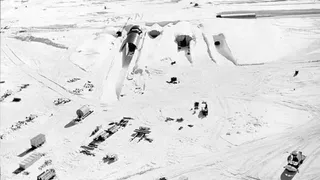
NASA has unveiled a striking image of a long-abandoned Cold War-era military base buried beneath the vast expanse of the Greenland Ice Sheet. Captured in April 2024 by Chad Greene, a cryospheric scientist with NASA, the photograph was taken during a research flight over the Arctic plateau. The base, situated approximately 150 miles east of the Pituffik Space Base in northern Greenland, offers a haunting glimpse into a hidden relic of geopolitical history, preserved under layers of ice.
The plane's radar detected the remnants of Camp Century, a Cold War-era base buried 100 feet beneath Greenland's ice sheet.
"We were searching for the ice bed, and unexpectedly, Camp Century appeared," said Alex Gardner, a cryospheric scientist at NASA's Jet Propulsion Laboratory (JPL).
NASA’s UAVSAR, mounted on the aircraft during April 2024 flights, provided detailed radar maps of Camp Century, revealing individual structures with unprecedented clarity. Comparing the radar map with historical layouts shows alignment with the base’s tunnels and facilities. However, interpreting the images is complex, as features like the ice bed appear above the base due to the radar’s dimensional perspective.
ALSO READ: Chinmoy Das Arrested: Bangladesh HC To Hear Plea Seeking Ban On ISKCON Amid Attacks On Hindus
What Is Camp Century?
Camp Century, built in 1959, was a US Cold War military base beneath Greenland's ice, featuring 21 tunnels spanning 9,800 feet. Officially a research facility, it also held strategic military and scientific importance.
In 1951, the US and Denmark signed the Defense of Greenland Agreement, allowing the US to build military bases in Greenland. During the Cold War, the US established three air bases—Narssarsuaq, Sondestrom, and Thule—for strategic bombers and radar stations to detect potential Soviet attacks. Today, Thule Air Base, the northernmost US Air Force base, remains operational.
ALSO READ: Imran Khans' PTI Condemns State-Sponsored Violence During Rally In Pakistan
Camp Century operated until 1966 before its tunnels collapsed and became buried under thick ice. Project Iceworm's military purpose was revealed in 1997. Scientists now warn that melting ice due to climate change could expose the site, which contains over 47,000 gallons of radioactive waste left from its nuclear reactor. Ice loss at the site is predicted to begin by 2090.