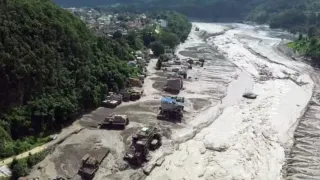
The devastating floods that swept Bhotekoshi in Nepal on Wednesday have left over 538 people dead. As the death toll continues to rise, morgues across several districts are running out of space.
The bodies from Rasuwa and Nuwakot are being recovered after they flow downstream with the ravaged floodwater. The bodies are being recovered in Chitwan, Tanahun, Gorkha and Nawalparasi.
According to a report by The Kathmandu Times, the authorities have set up temporary storage facilities to accommodate the bodies of victims. In Nuwakot, Dhadin and Nawalparasi, the morgues are running out of capacity. Consequently, the authorities are transferring remains to neighbouring districts, including Pokhara. However, the Pokhara facilities, including the hospitals, are nearing their limits.
A total of 93 bodies were transported to Pokhara from the neighbouring districts. The authorities have set up a temporary storage centre in Chitwan by converting an unused building after local hospitals struggled to accommodate more remains.
Chief District Officer of Kaski, Kuam Singh Gurung, said that hospitals in districts, including Pokhara Academy of Health Sciences, could collectively accommodate 88 bodies. "By the numbers, we are already above capacity,"
Gurung was quoted as saying by the Nepali media. Chief District Officer, Chitwan, Ganesh Aryal said that morgues in the district could hold only 30-50 bodies at a time. Adding a temporary facility would increase the storage capacity by 250 bodies.
The authorities are also planning to use the electric crematorium if capacity exceeds. Bharatpur Metropolitan City will repair and equip the Devghat crematorium, including installing air conditioners and using dry ice to slow decomposition.
Challenge to identify bodies
Besides storage, the other big challenge for the authorities is to identify the bodies. With several bodies still unidentified, the authorities have begun adopting procedures that would ensure that the bodies could be identified at a later stage.
The police are using fingerprints, photographs and DNA samples while conducting post-mortems. For those bodies with identifiable faces, the authorities have taken images.
Kaki police chief Superintendent of Police Nabin Karki said, "If relatives cannot be located or the bodies identified, we cannot keep them indefinitely because fingerprints and DNA samples are collected beforehand". The police have also introduced a QR code system to help families identify the dead.