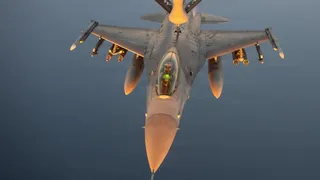
The US military announced Wednesday that it was conducting a 12th night of strikes against Iran as both sides increasingly targeted civilian infrastructure. US Central Command said the attacks were designed to “further degrade Iran’s ability to threaten civilian mariners and commercial vessels transiting regional waters,” as the Americans push to regain control over the Strait of Hormuz and restore the flow of international shipping.
US President Donald Trump warned earlier Wednesday that the US would destroy one bridge or power plant each time Iran shoots at a ship in the strait.
“From this point forward, any time the Islamic Republic of Iran shoots at a ship in the Strait of Hormuz, whether it be by Missile, Rocket, Drone, or any other device or weapon, the United States will bomb and destroy ONE BRIDGE OR POWER PLANT,” Trump wrote on social media.
The continued American airstrikes are occurring even as diplomatic efforts show little public sign of progress and officials on both sides have dug in on the dispute over the crucial waterway for global energy that remains largely closed. The unpopular war threatens further worldwide economic disruption and is sending fuel prices up ahead of midterm US elections this fall.
Iran vows a decisive response
Seyed Abbas Araghchi, Iran’s foreign minister, said his country would adopt an “eye for an eye” defence doctrine. “Any aggression against Iran, including our infrastructure, will compel a powerful and decisive response,” he posted Wednesday on X.
Iranian state media reported that U.S. missiles struck locations late Wednesday near the cities of Ahvaz, Ramshir and Andimeshk in western Iran. Two people were killed in a US missile strike in the town of Shalamcheh on the Iraqi border, Iranian state media said early Thursday.
Meanwhile, military officials in Kuwait said on social media that their air defences were “confronting attacks by hostile drones, following the sinful Iranian aggression.”
Iran has responded to US attacks by targeting energy infrastructure and desalination plants that provide drinking water in parched neighbouring Gulf countries.
The costs of war are mounting
The closure of the strait, through which a fifth of the world’s traded oil and gas passed during peacetime, has jolted the world economy with effects far beyond the Middle East. A new threat by Iran-backed Houthi rebels in Yemen to target Saudi shipping in the Red Sea puts another trade chokepoint at risk.
Trump travelled to Dover Air Force Base on Wednesday for the arrival of the remains of four U.S. service members. A day earlier, Defence Secretary Pete Hegseth estimated in a fiery Senate hearing that the U.S. had spent USD 37.5 billion on the war so far.
Benchmark Brent crude oil rose to more than USD 93 a barrel in trading. That’s up from less than $72 early this month, which is roughly where it was before the war. Gasoline prices are also climbing.
Iran says it has the right to manage traffic and potentially charge fees in the strait, which was open to all and toll-free before the war. It has attacked ships using a route through the strait that is overseen by U.S. forces and intended to be outside Tehran’s control.
Iran’s parliament speaker, Mohammad Bagher Qalibaf, who has led negotiations with the U.S., appeared to brush off Trump’s threats.
“We have repeatedly said that the situation of the strait will not return to prewar conditions,” he wrote on social media..
(Note: Except for the headline, this article has not been edited by The Daily Jagran and has been published through a syndicated feed. Source - PTI)
You may also like to watch