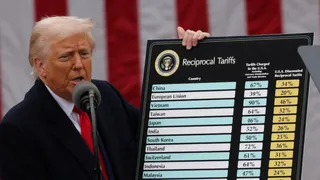
A document released by the White House on Friday showed that the Trump administration has adjusted its reciprocal tariff rates for at least 14 nations, including India. Initially, India's tariff was pegged at 27 per cent, a slight uptick from the 26 per cent Trump cited in his April 2 statement. The latest annexe, however, reflects a rollback to 26 per cent. President Trump, who has described himself as a close ally of Prime Minister Modi, argued that India's trade practices have been "unfair" to the US, justifying the 26 per cent tariff on the world’s fifth-largest economy.
South Korea's tariff rate has also seen revisions: Trump initially announced it at 25 per cent, the annexe later bumped it to 26 per cent, and now it's back to 25 per cent. Similar adjustments have affected countries like Botswana, Cameroon, Malawi, Nicaragua, Norway, Pakistan, the Philippines, Serbia, South Africa, Thailand, Vanuatu, and the Falkland Islands. Per an executive order enforcing Trump’s reciprocal tariff framework, a baseline 10 per cent tariff was applied to all US trading partners starting April 5. The annexe then specifies elevated rates for select nations. Curiously, some territories tied to larger countries—such as Reunion, originally slated for a 37 per cent tariff, along with Saint Pierre and Miquelon and Norfolk Island—were excluded from the final annexe altogether.
US tariffs to hit India's GDP growth, prompt more rate cuts
India's economic growth could slow by 20-40 basis points in the ongoing financial year due to the latest US tariffs, which would prompt deeper interest rate cuts by the central bank, analysts said. US President Donald Trump on Wednesday slapped a 26 per cent reciprocal tariff on India, threatening the Reserve Bank of India's (RBI) estimate of 6.7 per cent economic growth in 2025-26 and the government's economic survey forecast of 6.3 per cent-6.8 per cent. After the tariffs, Goldman Sachs lowered its growth estimate to 6.1 per cent from 6.3 per cent. Citi forecasted a 40 bps drag on growth directly and indirectly, while Mumbai-based QuantEco Research estimated a 30 bps hit.
Moreover, with inflation expected to average 4.2 per cent this financial year, close to the RBI's target, the central bank cut interest rates for the first time in five years in February. It is expected to follow that with another 25 bps cut to 6.00 per cent at the conclusion of its April 7-9 meeting, per a Reuters poll.
However, the poll showed that economists had expected just one more cut after that -- to a policy repo rate of 5.75 per cent in August -- before a prolonged pause, the US tariffs have prompted a rethink to those estimates. Goldman, Citi and QuantEco Research had also predicted just one to two more cuts this year, but now expect 75 bps of cuts this financial year, taking the policy rate to 5.5%, which would be the lowest since August 2022.
"This would be an appropriate risk minimization strategy on the face of larger downside risks to growth compared to much lower upside risk to inflation," Citi's India chief economist Samiran Chakraborty said in a note late on Thursday. The growth-inflation dynamics "open up policy space for the MPC (monetary policy committee) to support growth, while remaining focussed on aligning inflation with the target," the MPC said in February.
Growth expected to slow down
The Indian economy's growth is expected to have slowed to a four-year low of 6.5% in the financial year ended March 31, as urban demand weakened due to high inflation, tight liquidity and tougher RBI rules slowing loan growth across personal loans and credit cards. The central bank has, however, significantly eased liquidity conditions since new Governor Sanjay Malhotra took over in December. Plans to further tighten banking regulations have also been pushed back.
(With inputs from agency)