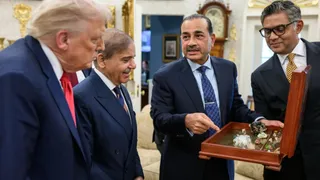
Pakistan, whose role seems critical in the peace negotiations between the US and Iran, has a history of facilitating deadly terror attacks in the world. Despite its past reputation, US President Donald Trump has seemed keen on taking the Islamic regime on board for peace negotiations with Tehran. It seems Trump’s memory perhaps has faded away when the same Islamic nation carried out a major terror attack on America that killed at least 3,000.
Why Trump might have chosen Pakistan for peace talks
Pakistan has a reputation as a relatively neutral player with long-standing ties to Iran's Islamic Republic. Besides, the Pakistan Prime Minister Shehbaz Sharif-led government has shown a puppet-like attitude when India carried out a major attack in response to the Pahalgam terror attack. The country was among the first to support Trump’s aspirations for the Nobel Peace Prize.
ALSO READ: US Proposes 15-Point Ceasefire Plan To Iran: Is Trump Close To Ending War?
On Tuesday, Sharif showed interest in hosting Islamabad as a place for talks. This is the first time that Trump has officially endorsed his sentiment on social media. He shared a screengrab of Sharif’s post on his social media platform, Truth Social.
If talks happen, it could raise Pakistan's global prominence to heights not reached since Pakistan helped mediate the secret diplomatic opening that led to US President Richard Nixon's visit to China in 1972. It would cap over a year of relationship building with Trump that has involved astute diplomacy and crypto deals.
Why Trump-Pakistan crypto deal in focus
Amidst Pakistan projected a key player in negotiating talks, a crypto deal is also gaining attention. In January, Pakistan struck a deal with a crypto business linked to Trump's family to use its USD1 stablecoin for cross-border payments, while White House envoy Steve Witkoff helped broker an agreement to redevelop New York's Roosevelt Hotel, owned by Pakistan's national airline.
Stablecoins - digital tokens typically pegged to the dollar - have ballooned in value in recent years.
Under Trump, the United States has introduced federal rules widely seen as beneficial to the sector, and countries across the world are beginning to examine the potential role of stablecoins in payments and financial systems. Experts believe projecting Pakistan in a key role, it may be Trump's latest attempt to give a return to Islamabad.
Pakistan-Iran relations
Pakistan, which maintains direct contact with both Washington and Tehran at a time when such channels are frozen for most other countries, would also benefit directly from an end to the war. The South Asian nation is home to the world's second-largest Shia Muslim population after Iran.
ALSO READ: Why India Stands Out As The Best Hope To Stop Israel US Iran War?
"Pakistan has unusual credibility as a mediator, maintaining workable ties with both Washington and Tehran, while a history of strained relations with each gives it just enough distance to be seen as a credible go-between," Adam Weinstein, deputy director of the Middle East program at the Quincy Institute, told Reuters.
“Close relations with Trump”
Pakistan's army chief Field Marshal Asim Munir has built a close relationship with Trump to repair years of mistrust. Pakistan joined Trump's Board of Peace just after Munir flew to Davos to meet Trump in January.
When and where will US-Iran peace negotiations start?
Pakistan has been involved in diplomacy to end the Iran conflict since it started, including shuttling at least half a dozen messages between the US and Iran, Reuters reported, citing five official Pakistani sources. Before Sharif confirmed the offer of talks on Tuesday, one of the Pakistani sources and a foreign source said that officials from both countries could hold talks in Islamabad as early as the end of this week.
The Pakistani source said US Vice President JD Vance, Witkoff and Trump's son-in-law Jared Kushner were expected to take part. According to official press releases, over the past month, Sharif and Pakistan's foreign minister have held over 30 conversations with counterparts in the Middle East, including half a dozen with Iranian officials.
(With inputs from agency)