
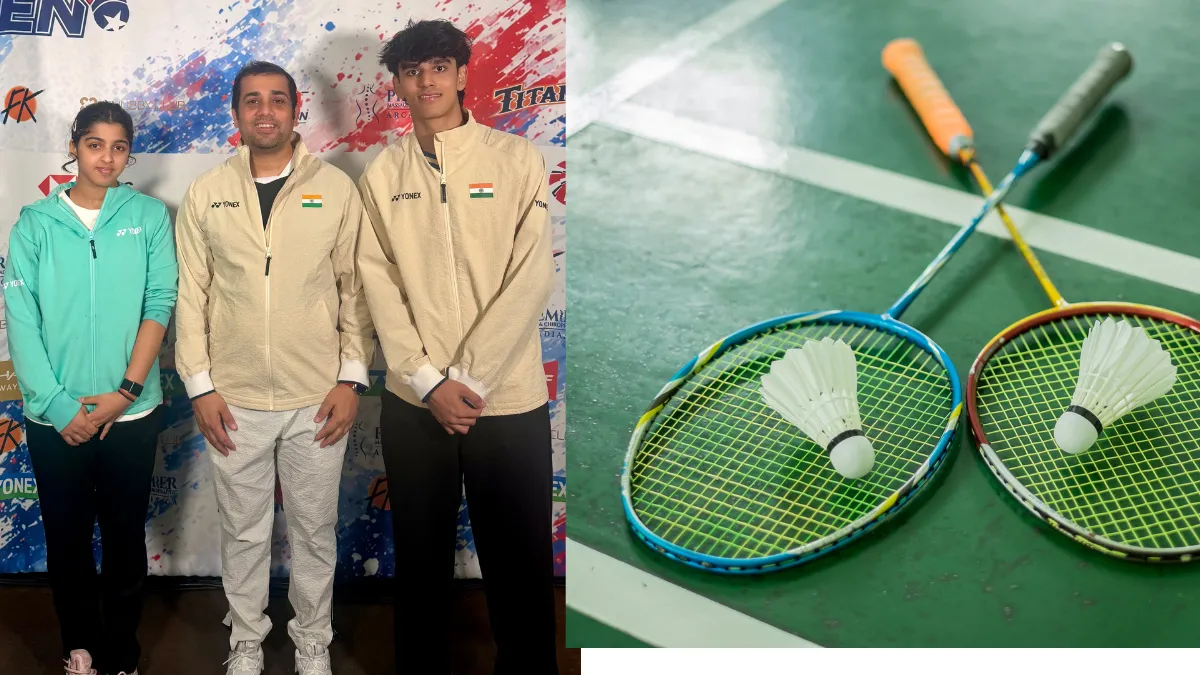
- Rohit Ranaut believes India needs a stronger, more focused approach to player development.
- The former national coach stressed that athletes should not be produced merely for the sake of numbers.
- He called for greater emphasis on long-term development, coaching quality and creating world-class players.
Indian badminton has established itself as a force on the international stage, producing world-class players across generations.
However, former national coach Rohit Ranaut believes the next challenge for the country is not simply producing more players, but developing athletes capable of sustaining excellence and competing for world titles.
Speaking exclusively to The Daily Jagran, Ranaut, who has worked with India's national team and several elite training centres for more than 13 years, said the focus of the country's badminton system should shift towards developing complete players rather than chasing numbers.
“Indian badminton has reached a stage where the question is no longer whether we can produce world-class players, as we have already proved that. The bigger challenge is making that excellence repeatable across generations,” Ranaut said.
According to the former national coach, becoming a world champion requires much more than technical ability. Decision-making, movement efficiency, tactical awareness, recovery, emotional control and adaptability can ultimately separate a good international player from a world-class one.
“Ultimately, I don't think India needs to produce more players simply for the sake of numbers. We need to develop more complete players — athletes who can solve problems on court, handle pressure and sustain their level over an entire career,” he stated.
Ranaut’s ‘Independence Method’ For Young Players
Ranaut has played a key role in the development of young Indian shuttlers, including Tanvi Sharma and Rounak Chouhan, and believes coaches should avoid forcing every player into the same mould.
“Tanvi and Rounak are very different players and personalities, and I think that's important. We never tried to make them fit the same template. We focused on understanding their individual strengths and building their competitive identity,” he said.
Ranaut explained his coaching philosophy through what he calls the “Independence Method”, which focuses on teaching players to solve problems rather than simply execute pre-planned drills.
View this post on Instagram
“We create match-like situations where their preferred options are taken away, forcing them to read the game, adapt and find solutions themselves,” he explained.
“The objective is to make them less dependent on instructions and more confident decision-makers under pressure. A good coach shouldn't solve the match for the player; they should teach the player how to solve it themselves.”
Recommended For You
Ranaut also highlighted Tanvi's consistency and ability to absorb feedback, while pointing to Rounak's confidence against higher-ranked opponents.
“Rounak wasn't playing the ranking; he was playing the opponent in front of him. His run to the semifinal was an important step in his development,” he said.
His advice to young shuttlers is straightforward: **“Don't chase the ranking; chase improvement. Rankings are a consequence of becoming a better player.”**
‘We Understand The Athlete Better Now’
The evolution of sports science has significantly changed badminton training over the past decade, according to Ranaut.
Video analysis, nutrition, recovery, sleep management, workload monitoring and mental conditioning have all become increasingly important parts of an athlete's development.
“The biggest change is that we understand the athlete much better today,” Ranaut said.
“Video analysis allows us to identify patterns rather than simply saying a player played well or badly. Sports science has made training more individualised, while nutrition, recovery, sleep and workload management have become integral parts of performance.”
He also believes mental conditioning needs to go beyond simply encouraging athletes to remain positive.
“It is about preparing them for real competitive situations — losing a lead, playing a higher-ranked opponent, recovering after a close game or making decisions under fatigue,” he explained.
However, Ranaut stressed that technology should remain a tool for coaches rather than a replacement for them.
“Technology should support coaching, not replace it. The coach's job is to turn all that information into something simple and useful that the player can execute on court,” he said.
Consistency Of Environment Around Athlete Is Key
Having worked at international events including the BWF World Junior Championships and the US Open, Ranaut has experienced different badminton environments and believes India's biggest opportunity lies in creating greater consistency throughout an athlete's development.
“I don't think it is useful to simply say that one country's system is better than another's. Every successful badminton nation has developed according to its own sporting culture,” he said.
“What I notice with the strongest badminton systems is the consistency of the environment around the athlete.”
According to Ranaut, technical standards, physical preparation, discipline, recovery and competitive habits need to be reinforced continuously throughout a player's journey.
India, he believes, has already made significant progress, with world-class training centres, experienced coaches and increasingly sophisticated support teams.
However, he feels the transition between different stages of a player's career needs greater attention.
View this post on Instagram
“The player who is 14 needs to understand, in an age-appropriate way, what they will eventually need at 20. Similarly, the transition from junior to senior badminton needs to be planned rather than left to chance,” Ranaut said.
He also believes international tournaments should be viewed as learning opportunities rather than being judged purely by results.
“A tournament isn't successful only because you win. Sometimes a player learns more from a difficult loss against a world-class opponent than from an easy victory,” he added.
‘Don’t Simply Copy China, Japan Or Korea’
While countries such as China, Japan and South Korea have established highly successful badminton systems, Ranaut does not believe India should simply replicate their models.
“I would not want India to simply copy China, Japan or Korea. We should study what works in those systems, understand why it works, and then build an Indian high-performance model around our own strengths,” he said.
For Ranaut, the objective should be to develop a system that connects junior development with senior international success, ensuring young players are prepared for the physical, tactical and psychological demands of elite badminton.
ALSO READ: 'Made A Place In People's Hearts': Soman Rana Opens Up On CWG 2026 Gold Win | Exclusive
‘You Don’t Have To Become A Champion At 14’
Ranaut's message to young players, coaches and parents is centred around patience.
“You don't have to become a champion at 14, 16 or 18. Every player develops differently, and losses, setbacks and difficult periods are part of the journey,” he said.
He urged young coaches to continue learning as the sport and performance science evolve, while asking parents not to judge their children's development solely through trophies and rankings.
“Let your child enjoy badminton. Don't judge development only by trophies or rankings,” Ranaut said.
He believes a difficult defeat can sometimes contribute more to a player's long-term development than a junior tournament victory.
“The goal shouldn't simply be to create a child who wins junior medals. It should be to develop an athlete who can walk onto a senior international court representing India and believe they belong there,” Ranaut concluded.