
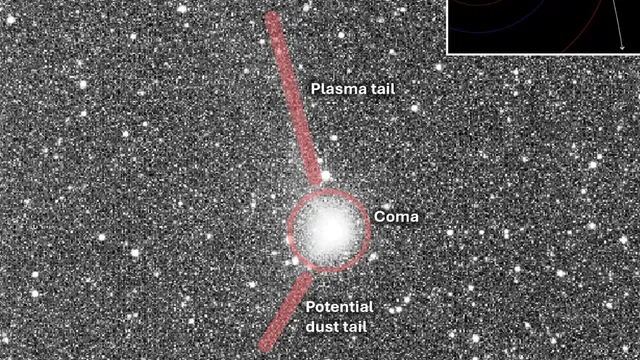
3I/ATLAS update: Europe’s space community is buzzing after the European Space Agency (ESA) confirmed that the interstellar comet 3I/ATLAS is racing through the solar system on a trajectory that will take it to Jupiter well before the Juice spacecraft reaches the gas giant. The revelation followed the release of a striking new navigation-camera image that has renewed public fascination with this rare interstellar visitor.
What Has ESA confirmed?
The discussion began after ESA noted that 3I/ATLAS will reach Jupiter in March 2026, nearly five years before the Juice probe’s scheduled arrival in July 2031. Scientists say the reason is simple: interstellar objects enter the solar system at extremely high speeds because they are not gravitationally bound to the Sun.
The comet crossed paths with Juice in early November, giving mission controllers an unusual opportunity to study a fast-moving, hyperbolic object using instruments that were originally designed for Jupiter’s icy moons.
☄️ Our #ESAJuice team couldn't wait until February, when they will receive data on #3IATLAS from the mission's science instruments.
— ESA Science (@esascience) December 4, 2025
So they downloaded just a quarter of an image from its navigation camera to get a surprise sneak preview.
More info and annotations 👉… pic.twitter.com/e8JGpOkCfd
Perihelion passage and High-speed Trajectory
3I/ATLAS reached its perihelion, the closest point to the Sun on October 29, 2025, at a distance of about 202.9 million kilometres. During this period, it was hidden behind the Sun from Earth-based telescopes. A week later, Juice began its observation campaign.
The comet’s velocity, scientists note, will continue to remain higher than almost any active spacecraft because 3I/ATLAS is following a hyperbolic orbit, typical of objects arriving from interstellar space. Its rapid motion is also why it will continue outward and leave the solar system after its Jupiter approach. ESA engineers, eager to see what Juice managed to record, downloaded a quarter of a NavCam image taken on November 2. Despite the navigation camera’s limited scientific resolution, the picture showed a well-defined coma, a glowing cloud of gas and dust, and likely indications of two developing tails.
According to ESA, the brighter upper extension in the frame is the plasma tail, formed as solar wind interacts with ionised gases. A faint structure extending diagonally appears to be the dust tail, composed of tiny solid grains shed by the comet as it heated during perihelion. Juice had made its closest approach two days later, on November 4, passing at a distance of nearly 66 million kilometres.
Hubble Reobserves Comet As It Races Outward
Because the spacecraft is currently using its high-gain antenna as a heat shield, engineers have switched to the slower medium-gain antenna for communication. This is why the full dataset will not reach Earth until February 2026. ESA plans to release detailed measurements from five instruments, JANUS, MAJIS, UVS, SWI, and PEP, on February 18 and 20, 2026.
These will include optical imagery, spectroscopic readings, composition data, and particle environment analysis, offering the clearest view yet of how an interstellar comet behaves as it passes through the inner solar system.
Adding to the excitement, NASA’s Hubble Space Telescope reobserved 3I/ATLAS on November 30, capturing the comet from a distance of about 286 million kilometres. Because Hubble tracked the comet’s rapid motion, background stars appeared as long streaks, which is a visual proof of the object’s high speed.
🆕 Hubble reobserved interstellar comet #3IATLAS on 30 November with its Wide Field Camera 3 instrument. At the time, the comet was about 286 million kilometres from Earth: https://t.co/XW6zLkOpG8
— HUBBLE (@HUBBLE_space) December 5, 2025
Hubble tracked the comet as it moved across the sky. As a result, background… pic.twitter.com/dRQAaV1t8p
With multiple missions following its path, scientists expect to study 3I/ATLAS for several more months before it disappears into deep space once again.