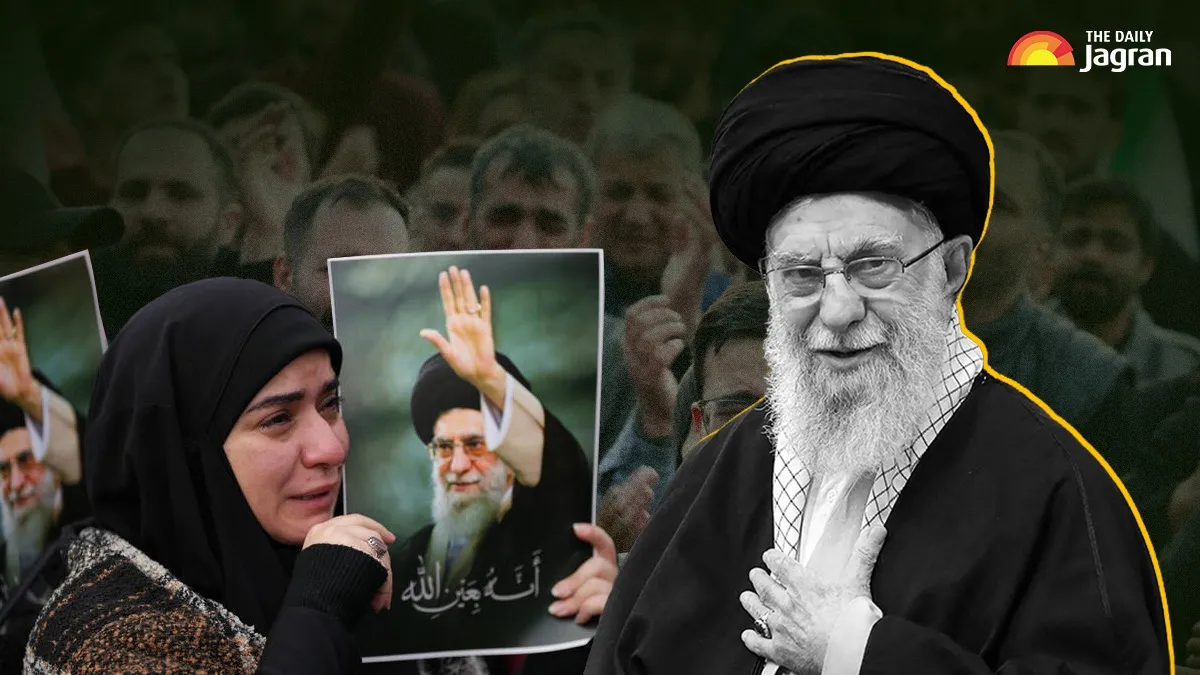
- Iran Bids Farewell to Ayatollah Ali Khamenei Amidst Massive Turnout and Global Presence.
- For security reasons, the current Supreme Leader, Mojtaba Khamenei, will not attend the public ceremonies.
- Khamenei's body had been preserved in refrigerated cold storage at a forensic mortuary during this period.
Ayatollah Ali Khamenei Funeral: After nearly four months, the funeral ceremonies of former Iranian Supreme Leader Ayatollah Ali Khamenei and several members of his family began on Friday. Khamenei's body had been preserved in refrigerated cold storage at a forensic mortuary during this period.
As Islamic tradition does not permit chemical embalming, only low-temperature preservation was used. Under Shia religious customs, permission was granted to delay the burial and preserve the body due to the extraordinary circumstances created by the war.
According to Iran's state news agency IRNA, the ceremonies will continue until July 9. Khamenei's body is lying in state at Tehran's Grand Mosalla Mosque before a funeral procession through the capital on Monday. The event is not being observed solely as a period of national mourning; Iran is also presenting it as a demonstration of its religious, political, and popular strength.
Further rites are scheduled in Qom and later in Baghdad, Karbala, and Najaf before Khamenei is laid to rest in Mashhad on July 9.
Tehran Expected To See Up To 20 Million Mourners
The Iranian government and the country's religious leadership have appealed to citizens to gather in large numbers to pay tribute to Khamenei.
According to Press TV, the ceremonies are expected to become one of the largest international gatherings in Iran since Khamenei's death. Iranian officials estimate that between 15 and 20 million mourners will participate in the multi-day funeral.
Who Is Being Honoured?
The coffins of Khamenei and several members of his family have been placed at Tehran's Grand Mosalla Mosque. These include one of his sons-in-law, his eldest daughter, his 14-month-old granddaughter Zahra Mohammadi Golpayegani, and the wife of the new Supreme Leader, Mojtaba Khamenei.
Recommended For You
Khamenei's coffin has been draped in the Iranian national flag, while a red flag bearing the words "Ya Hussain" has been placed on top.
Will Mojtaba Khamenei attend?
For security reasons, the current Supreme Leader, Mojtaba Khamenei, will not attend the public ceremonies.
Meanwhile, millions of mourners have gathered on the streets of Tehran. Men, women, children, and elderly people have been paying their respects while chanting slogans in tribute to Khamenei and in support of Iran's leadership.
Several senior Iranian officials have already visited the Grand Mosalla complex to offer their condolences, including President Masoud Pezeshkian, Foreign Minister Abbas Araghchi, Parliament Speaker Mohammad Bagher Ghalibaf, Chief Justice Gholam-Hossein Mohseni-Ejei, and senior military official Mohsen Rezaei.
Is Iran Sending a Message to the US?
Experts believe Iran intends to use the unprecedented public turnout and international participation to send a message to the United States, Israel, and the wider world that its political and religious establishment remains strong despite the war.
The display of strength is also being viewed as an attempt to gain psychological leverage ahead of any potential peace negotiations with the United States and over strategic issues related to the Strait of Hormuz.
US President Donald Trump has repeatedly claimed that he altered Iran's political order and weakened its economic and military capabilities.
Meanwhile, Pakistan, Russia, and China have confirmed they will send official delegations. During the mourning period, Khamenei's body will also be taken to several cities in Iraq in addition to different parts of Iran.
More than 30 countries are expected to send heads of state or official representatives, while religious delegations from around 90 countries are also expected to attend.
Security on High Alert
According to AP, authorities have declared a nationwide high alert in anticipation of millions of mourners. Just like during the funeral of Ayatollah Ruhollah Khomeini in 1989 and the burial of General Qasem Soleimani, massive crowds triggered stampede-like situations that claimed numerous lives. Authorities are therefore placing special emphasis on security arrangements and crowd management during Khamenei's funeral.
Which Foreign Leaders Are Attending?
Foreign dignitaries have continued arriving in Tehran for the funeral ceremonies.
Pakistan Prime Minister Shehbaz Sharif and Army Chief Field Marshal Asim Munir, along with delegations from China, Oman, Georgia, and Iraq, have confirmed their attendance. Lebanon's Amal Movement, Palestinian representatives, and religious leaders from several other countries are also participating.
According to The New York Times, former Russian President Dmitry Medvedev, Saudi Arabia's Deputy Foreign Minister, Nechirvan Barzani, President of Iraq's Kurdistan Region, members of the Iran-backed Kataib Hezbollah, senior Taliban leader Mullah Abdul Ghani Baradar, Taliban Foreign Minister Amir Khan Muttaqi, and Ahmad Massoud, son of anti-Taliban leader Ahmad Shah Massoud, have also arrived to pay tribute to Khamenei.
Complete Schedule of Ayatollah Ali Khamenei's Funeral
July 3: Tribute ceremonies began in Tehran.
July 4-5: The coffins of Ali Khamenei and his family members will remain at Tehran's Grand Mosalla Mosque for public viewing and tributes. Large numbers of foreign dignitaries and members of the public are expected to visit.
July 6-7: The funeral procession will travel through different parts of Tehran before reaching Qom, the country's most important centre of Islamic learning, where Khamenei received his religious education.
July 8: Public funeral processions will be held in Najaf and Karbala, Iraq. Najaf is home to the Imam Ali Shrine, while Karbala houses the shrines of Imam Hussain and his half-brother Abbas, among the holiest sites in Shia Islam.
July 9: Khamenei's body will be brought back to Iran and buried at the Imam Reza Shrine in Mashhad. Imam Reza, the eighth Imam, is one of the most revered figures in Shia Islam, and his shrine is among the religion's most important pilgrimage destinations.
You May Also Like To Watch
The Middle East conflict escalated after the killing of 86-year-old Iran's Supreme Leader, Ayatollah Ali Khamenei, in joint US-Israeli military strikes. In retaliation, Iran targeted Israeli and US assets across several Gulf countries and Israel, disrupting key waterways and affecting international energy markets and global economic stability since February 28.