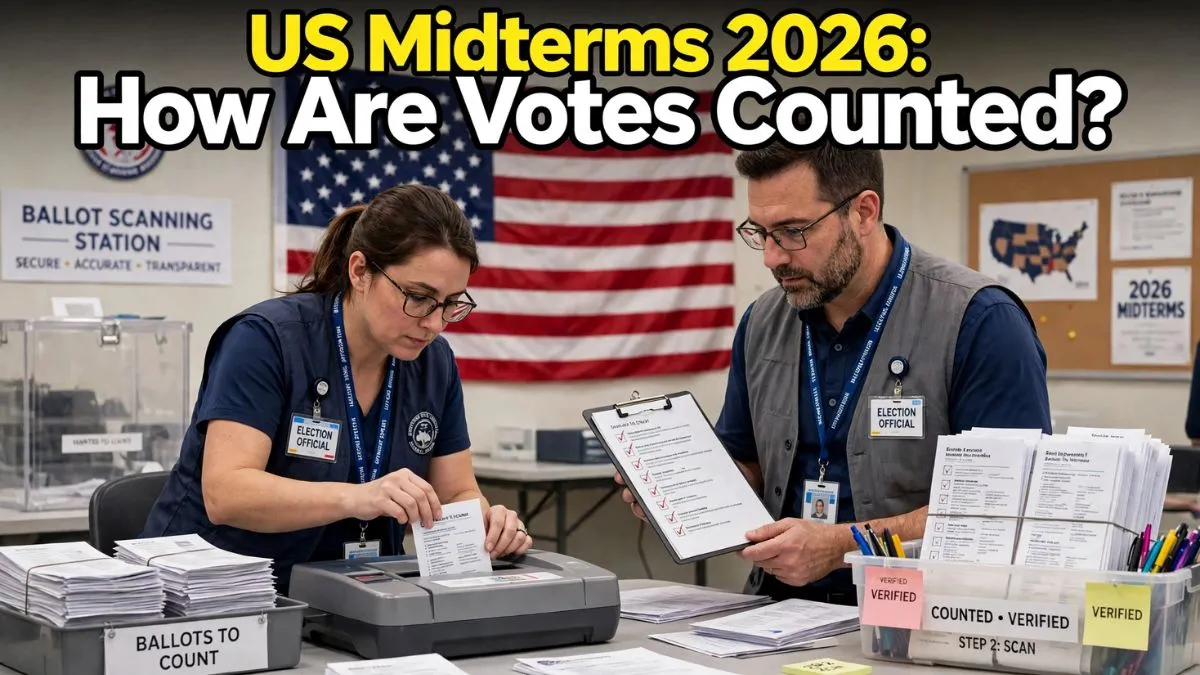
- US voters cast ballots via in-person, early, or mail.
- Vote counting includes machines, manual checks, and ballot curing.
- Winners determined by majority, runoffs, or ranked-choice voting.
US Midterm Elections 2026: Voters began arriving at polling stations across the United States on Tuesday as voting got underway in the 2026 US midterm elections. The outcome will determine whether President Donald Trump's Republican Party retains control of the House of Representatives and the Senate, the two chambers of the US Congress. It will also shape how easily Trump can advance his agenda during the final two years of his second term in office.
All 435 seats in the House of Representatives and all 100 seats in the Senate are at stake. Republicans currently hold a 218-214 majority in the House, which also has two vacancies and one independent lawmaker who caucuses with Republicans. Democrats need a net gain of four seats to take control of the chamber.
In the Senate, Republicans hold a 53-47 majority. Democrats need to gain four seats to secure control.
As millions of Americans head to the polls on November 3, an important question arises-- What happens after voters cast their ballots? How are votes counted and verified, and how is the winner determined? Let's take a look at the process.
Recommended For You
How Are Votes Cast?
US voters can cast their ballots in person on Election Day, through early voting or by mail, depending on their state's rules. Some states automatically send mail-in ballots to all registered voters, while others require voters to request them.
In certain states, mail-in ballots can be counted after Election Day, provided they are postmarked by the deadline. The US Supreme Court has upheld such practices.
Most paper ballots are counted using machines, although some are also checked manually to ensure accuracy. Election results are generally reported in batches as votes are processed.
In some states, officials begin processing mail-in ballots before Election Day, but the results are not made public until polling stations close.
Some states also allow voters additional time to correct errors or resolve issues with their mail-in ballots. For instance, voters may be asked to provide missing information or verify their signatures. This process, known as ballot curing, can mean that some ballots are counted later than others.
ALSO READ: Over 57 Million Americans Voted Early For US Midterm Elections: What's Driving The Early Turnout?
Vote counting can take longer in states with larger populations or more flexible voting rules, particularly those that allow widespread mail-in voting or provide additional time to correct ballot-related issues.
The process can also take longer in closely contested elections, where narrow margins make every vote potentially decisive.
According to MIT's Election Data and Science Lab, California had counted more than 75 per cent of its votes within two days of the 2024 election.
ALSO READ: US Midterm Elections 2026: What Happens If Democrats Win Both Chambers Of Congress?
Although media organisations often project a winner before the official results are final, election authorities must first review and certify the vote totals. If the margin between candidates is particularly narrow, a recount may also be required under state election laws, potentially delaying the final outcome.
How Is the Winner Decided?
In most US states, the candidate who receives the highest number of votes wins, even without securing an absolute majority.
However, some states follow different rules. Georgia and Louisiana, for instance, require candidates to secure at least 50 per cent of the vote to win outright. If no candidate reaches this threshold, a runoff election is held later between the top two candidates.
Meanwhile, states such as Maine and Alaska use ranked-choice voting in certain elections. Under this system, voters rank candidates in order of preference. If no candidate receives a majority of first-choice votes, the candidate with the fewest votes is eliminated, and their votes are redistributed according to voters' next preferences. This process continues until a candidate secures a majority.
Once counting and verification are complete, election authorities certify the final results. Certification is the official process through which authorities confirm that the reported totals accurately reflect the valid ballots cast.
You may also like to watch
This process can take several days or sometimes weeks, depending on the state and the election.