
- By Ajeet Kumar
- Thu, 17 Apr 2025 06:02 PM (IST)
- Source:JND
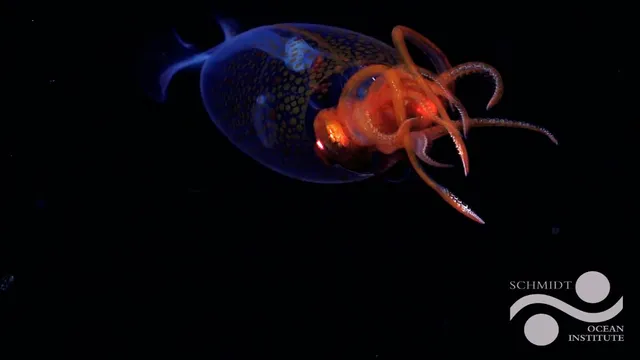
In a major breakthrough, scientists documented a "colossal squid" swimming deep in the ocean-- 100 years after the marine creature was first identified and named. The video was taken by a global team on the Schmidt Ocean Institute's ship, Falkor. They used an underwater robot called SuBastian to capture the young squid, which was about 30 centimetres long, at 600 meters deep near the South Sandwich Islands in the South Atlantic on March 9.
Until now, scientists found colossal squid dead
This year is the 100th anniversary of the colossal squid's discovery. Surprisingly, the squid was formally recognised and detailed in 1925, but until now, no one has been able to capture it alive on camera. According to scientists, these squids can expand up to 7 meters and weigh 500 kilograms, making them the heaviest invertebrates (animals without a solid line of bones (backbone) going along their bodies) on Earth. Until now, scientists claimed they only discovered them dead, inside whales or seabirds, not alive in the ocean.
Another rare squid captured
Dr Kat Bolstad, a squid expert, said in a statement, "It's thrilling to see a young colossal squid alive. They probably don't even know we exist!" Bolstad said that the the team was part of the Ocean Census project, searching for new sea creatures, with researchers from the UK, Germany, and the British Antarctic Survey. The scientists also filmed another rare squid, the see-through Galiteuthis glacialis (glass squid), near Antarctica in January at 687 meters deep. It floated with its arms up, looking like a cockatoo (a parrot species bird) .
Notably, the Nippon Foundation–Nekton Ocean Census is the world's largest mission to accelerate the discovery of ocean life. With only 2,40,000 marine species documented and millions more yet to be discovered, the Ocean Census is working to close critical biodiversity knowledge gaps.
Indian-Origin scientist hails findings
Dr Jyotika Virmani, an Indian-Origin scientist and executive director at the Schmidt Ocean Institute, in a statement released on Wednesday, April 16, called the findings a breakthrough and added the deep ocean is a mystery that must be explored. "Finding two rare squids on these trips shows how much we still don't know about the deep sea. It’s amazing!"
The SuBastian robot has now filmed four squid species in the wild for the first time, including the Ram’s Horn Squid in 2020 and Promachoteuthis in 2024. Another new squid discovery is still being studied. Dr Virmani added, "The ocean is full of mysteries waiting to be explored." "Fortunately, we caught enough high-resolution imagery of these creatures to allow the global experts, who were not on the vessel, to identify both species," she noted.
The Indian-origin scientist revealed that as of now, the Schmidt Ocean Institute's ROV SuBastian captured the first confirmed footage of at least four squid species in the wild, including the Spirula Spirula (Ram's Horn Squid) in 2020 and the Promachoteuthis in 2024, with one more first sighting yet to be confirmed. "These unforgettable moments continue to remind us that the Ocean is brimming with mysteries yet to be solved," Virmani said.