
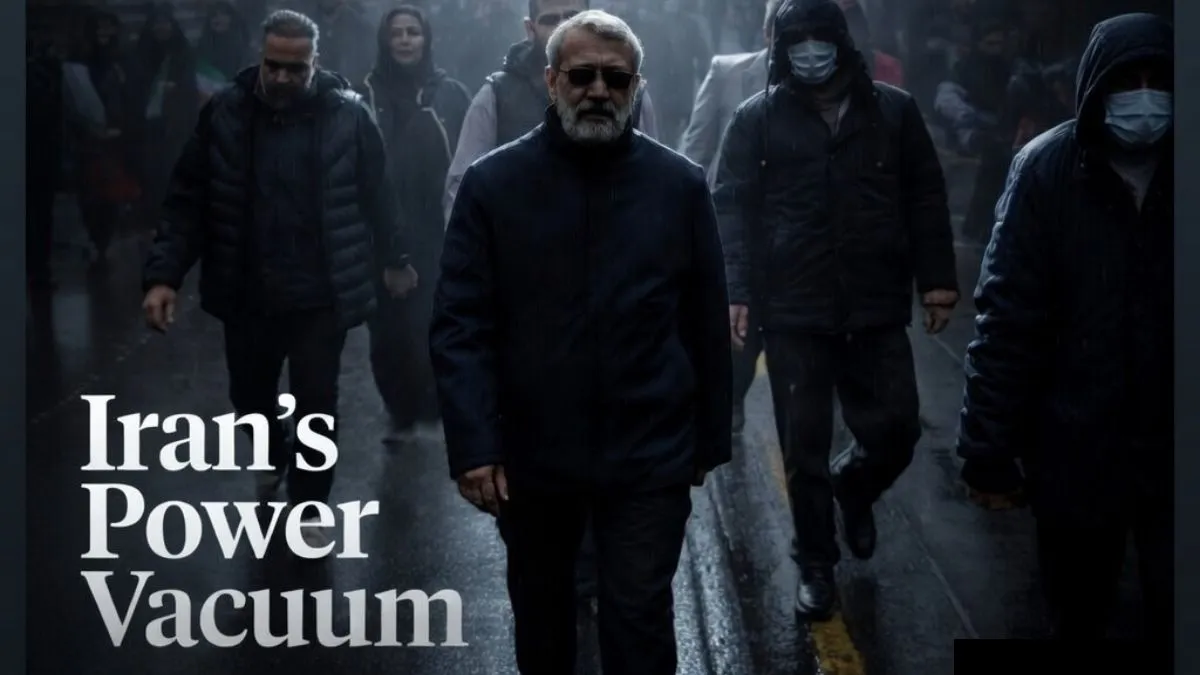
- Senior adviser Ali Larijani killed in US-Israeli air attack.
- Iran's political structure remains solid despite leadership losses.
- Foreign Minister asserts system doesn't rely on single individual.
Ali Larijani, a senior adviser to Iran's late Supreme Leader Ayatollah Ali Khamenei, was killed at the age of 67 by a US-Israeli air attack in Tehran. The killing came at a time when 40 other top leaders, including officials, were killed on February 28. Larijani was one of the most powerful figures in the Islamic Republic. He was considered an architect of its security policy and a close adviser to Ayatollah until the supreme leader's death in an airstrike last month. Despite the killings of top leaders, Iran continues to attack its neighbours and vows to take revenge for the killings.
So, how is the Iranian regime working smoothly despite a wider power vacuum?
Responding to the leadership question, Iranian Foreign Minister Abbas Araghchi has asserted that the political infrastructure of the nation remains a "very solid structure" and does not suffer a "fatal blow to Iran's leadership" following the confirmed killing of Ali Larijani.
Iranian leadership working mechanism
In an interview with Al Jazeera, which was broadcast after the death of Larijani was confirmed by Tehran early on Wednesday, Araghchi asserted that the United States and Israel have yet to realise that the Iranian government "does not rely on a single individual."
Recommended For You
"I do not know why the Americans and the Israelis still have not understood this point: The Islamic Republic of Iran has a strong political structure with established political, economic, and social institutions," Araghchi said.
Iran's Foreign Minister Abbas Araghchi on the killing of Ali Larijani:
— Clash Report (@clashreport) March 18, 2026
I do not know why the Americans and the Israelis still have not understood this point.
The Islamic Republic of Iran has a strong political structure with established political, economic, and social… pic.twitter.com/v6cgyjaoU3
Absence of a single individual does not affect this structure: Aragchi
The Foreign Minister emphasised that the "presence or absence of a single individual does not affect this structure." He noted that while "individuals are influential, and each person plays their role--some better, some worse, some less--but what matters is that the political system in Iran is a very solid structure."
ALSO READ: 'Yes, I'm Alive': Netanyahu Blasts Death Rumours In New Video With US Ambassador | Watch
Araghchi highlighted the earlier loss of the country's former supreme leader, Ayatollah Ali Khamenei, who was killed during the initial phase of US-Israeli strikes on 28 February. He remarked that despite the immense national loss, "the system continued" to function.
"We have not had anyone more important than the leader himself, and even the leader was martyred, yet the system continued its work and immediately provided a replacement," the minister said. He further maintained that "if anyone else is martyred, it will be the same," adding that "if the foreign minister were ever to be martyred, there would ultimately be someone else to take the position."
ALSO READ: 'Beware, Lest You Be Eliminated!' Iran's Security Chief Retorts With Threat As Trump Warns Mojtaba
How is the Iranian regime working after leadership killings?
Iran’s government isn’t simply about who occupies a position of power; it’s a deeply rooted structure with layers of political, economic, and social institutions.
The system is designed to endure shocks, with multiple “key individuals” ready to step in if a top figure is removed. Analysts often highlight that at least seven high-ranking officials share the same strategic mindset, ensuring continuity in decision-making.
In other words, removing a single leader, even someone as influential as Larijani, doesn’t destabilise the system. Iran would only face existential pressure if the entire nation itself were threatened. Otherwise, succession and replacement mechanisms are already built into the framework, making the government remarkably resilient.