

As many as 274 people were killed and 1,0 were injured after Israel launched a wave of airstrikes against Hezbollah in Lebanon on Monday, marking one of the most extensive military actions in the ongoing conflict. The Lebanon Health Ministry stated that children, women and paramedics were among those killed in the IDF strikes across the country. Earlier in the day, the Israeli military confirmed around 300 strikes on Hezbollah positions, fueling concerns of a full-scale war in the Middle East.
Israeli authorities have urged Lebanese civilians to evacuate areas where Hezbollah is suspected of storing weapons. Israeli Defence Minister Yoav Gallant stated that Israel is deepening its attacks in Lebanon. "The actions will continue until we achieve our goal to return the northern residents safely to their homes," he added.
The Israel Defense Forces (IDF) announced that its Chief of General Staff approved the large-scale strikes from the IDF’s Underground Operations Center. In a social media post, the military reported over 300 Hezbollah targets had been hit by Monday, including strategic locations across southern Lebanon.
Residents in southern Lebanon received warnings to evacuate areas near Hezbollah facilities. According to a Reuters reporter, phone calls originating from Lebanese numbers instructed civilians to distance themselves by at least 1,000 metres from Hezbollah posts. These evacuation warnings extended as far as Beirut, reflecting the intensifying nature of the conflict.
ALSO READ: How Israel Planned Pagers And Walkie Talkie Detonations In Lebanon? Here's What Report Say
Monday's airstrikes came amid the heaviest cross-border fire between Israel and Hezbollah in nearly a year. Israeli army spokesperson Avichay Adraee indicated earlier that air raids targeting Hezbollah weapons storage sites in Lebanon were imminent. Witnesses in Lebanon, including those in the southern port city of Tyre, reported hearing low-flying Israeli warplanes and nearby explosions.
Hezbollah's al-Manar television confirmed Israeli airstrikes across southern Lebanon and the Bekaa Valley, showing footage of smoke plumes rising over several towns. Israeli warplanes also bombed the northern Hermel area, a significant Hezbollah stronghold.
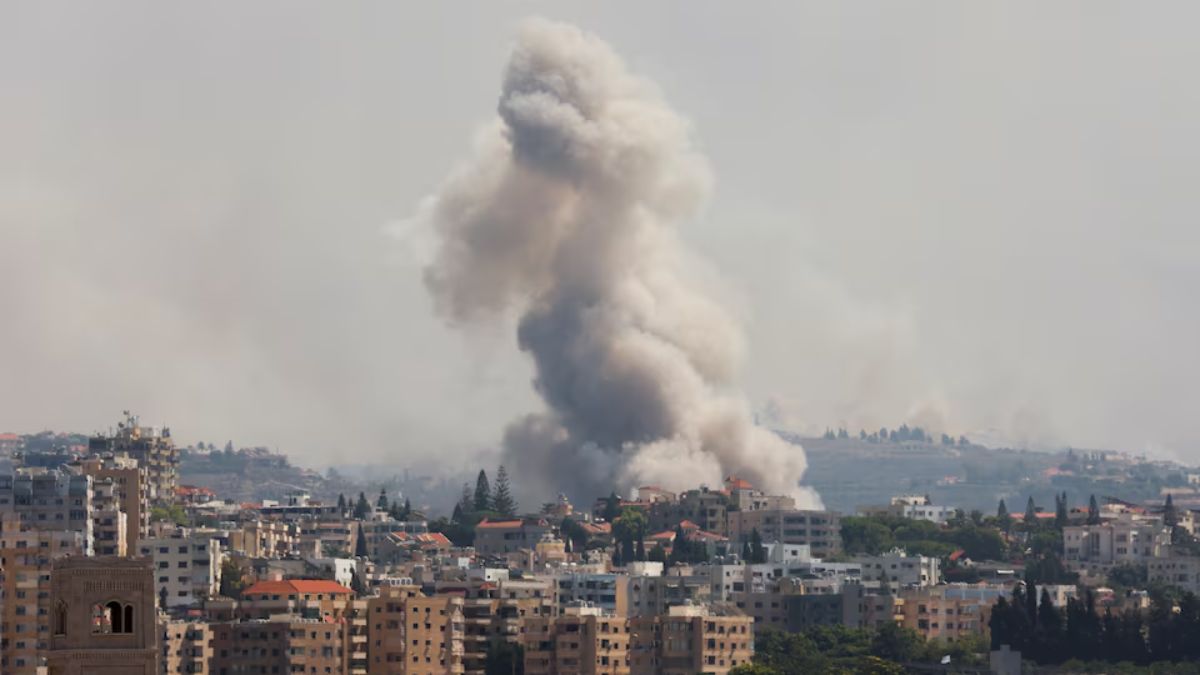
Smoke billows over southern Lebanon following Israeli strikes, amid ongoing cross-border hostilities between Hezbollah and Israeli forces, as seen from Tyre, southern Lebanon. (Image: Reuters)
The Gaza conflict and the parallel clashes between Israel and Hezbollah have raised fears of a broader regional confrontation, with potential involvement from the US and Iran. Israeli Defense Minister Gallant revealed that he had spoken with US Secretary of Defense Lloyd Austin to discuss both the strikes on Hezbollah and broader threats posed by Iran and its proxies.
Hezbollah, backed by Iran, has vowed to intensify its actions. Speaking at a funeral for one of the group’s slain commanders, Hezbollah's deputy chief Naim Qassem declared that the conflict had entered a "new phase," calling it an "open-ended battle of reckoning."
Hezbollah has been under immense pressure following a series of explosions last week that destroyed pagers and walkie-talkies used by its members. The attacks were widely attributed to Israel, although Israel has not claimed responsibility. Additionally, an Israeli airstrike on Friday in Beirut’s southern suburb killed 45 people, including senior Hezbollah leaders Ibrahim Aqil and Ahmed Wahbi.
Hezbollah Vs IDF Military Comparison
Tabular comparison of the military capabilities of Hezbollah and Israel, focusing on key aspects for clarity:
Aspect | Hezbollah | Israel Defense Forces (IDF) |
Active Personnel | About 1,00,000; exact numbers not disclosed | About 1,73,000 active, plus 3,00,000 reservists |
Rockets & Missiles | Over 150,000 rockets and missiles | Advanced missile systems including Arrow and Iron Dome |
Rocket Models | Iranian-made Raad, Fajr, Zilzal; Russian-made Katyusha | Various U.S.-made systems; Iron Dome for defence |
Anti-Tank Missiles | Kornet, Iranian Toophan (reverse-engineered TOW) | Advanced tanks (Merkava); anti-tank missiles |
Anti-Ship Missiles | Russian-made Yakhont | Advanced naval systems, including Iron Dome for naval |
Drones | Locally assembled Ayoub and Mersad models | Advanced drones for reconnaissance and strike |
Air Defence Capabilities | Surface-to-air missiles, limited drone interception | Iron Dome, David's Sling, Arrow systems |
Tanks | Limited; not a primary focus | About 2,200 tanks, mainly Merkava |
Artillery | Basic artillery; focus on rockets and missiles | 300 towed artillery pieces, 650 self-propelled guns, 300 rocket artillery systems |
Air Force | Limited; occasional use of surface-to-air missiles | Strongest in the region; includes Kfir and F-35 jets |
Special Forces | Effective in guerrilla tactics | Highly trained units like Sayeret Matkal |
Budget | Limited resources; primarily Iranian and local support | About USD 24.3 billion, substantial US aid |
Overall Military Approach | Rocket barrages, asymmetric tactics | Conventional military with advanced technology and support infrastructure |
This table captures the main elements of military strength and capabilities for both Hezbollah and the IDF. (Info source: Newsweek)