
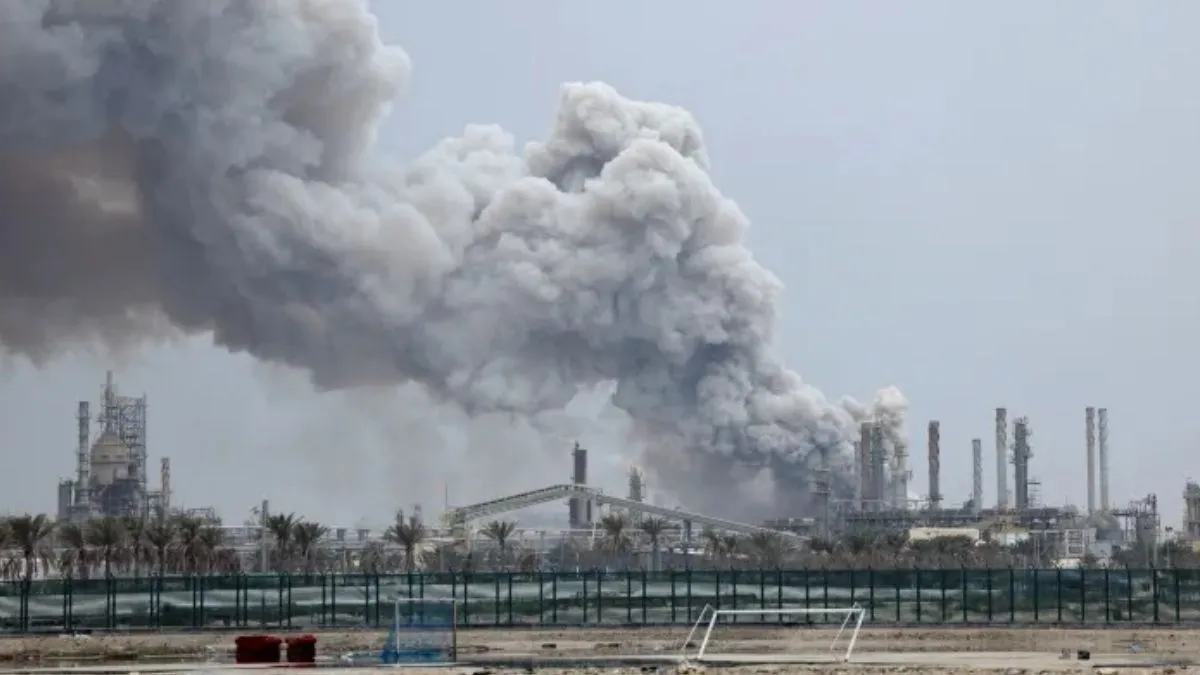
Tensions in the Middle East involving the United States, Israel and Iran have sharply escalated following a series of strikes and counterstrikes. The latest development in the conflict that has entered its 19th day centres around the attack on the South Pars Gas Field, the world’s largest natural gas reserves. Israel carried out a strike on Iran’s South Pars, targetting a relatively small section of the vast gas field.
Qatar, which shares the same gas field with Iran confirmed damage to energy-related sites. It is known as the North Dome in Qatar. The United Arab Emirates also reported disruptions at gas infrastructure. Iran has retaliated for a strike on a gas field by launching drones and ballistic missiles, some of which were intercepted by Saudi Arabia. United States President Donald Trump, in a post on Truth Social, clarified that he had no prior knowledge of the strike or Israeli actions.
“Israel, out of anger for what has taken place in the Middle East, has violently lashed out at a major facility known as South Pars Gas Field in Iran. A relatively small section of the whole has been hit. The United States knew nothing about this particular attack, and the country of Qatar was in no way, shape, or form, involved with it, nor did it have any idea that it was going to happen,” Trump wrote.
Recommended For You
Why Is South Pars Important For Iran, Qatar?
The South Pars or North Dome field is the world's largest natural gas field, located in the Persian Gulf, roughly 105 km southwest of Iran's Asalouyeh port. It is a shared resource, with roughly one-third of it controlled by Iran and two-thirds by Qatar. The gas field was first discovered in 1990. According to the International Energy Agency (IEA), the field holds around 1,800 trillion cubic feet of in-situ natural gas and about 50 billion barrels of natural gas condensates. Due to its vast capacity, South Pars is considered crucial to the global energy system. According to the Paris-based International Energy Agency, around 80 per cent of all power generated in Iran comes from natural gas, which makes the operation of this field more significant.
The gas field also makes Qatar one of the world's leading exporters of Liquefied Natural Gas (LNG), supplying it to markets across Asia and Europe. The reserve provides the vast majority of Iran's domestic natural gas and facilitates exports. Therefore, any disruption to this gas field can disrupt flow to global energy markets, affecting prices and supply chains. According to a Reuters report, the entire reservoir contains an estimated 1,800 trillion cubic feet of usable gas which is enough to supply the entire world's needs for 13 years, or to generate enough electricity to supply the US for more than 35 years.
How Attack On South Pars Can Endanger India's Energy Supply?
The attack on South Pars can disrupt energy flow to India as it buys significant amounts of LPG from Qatar. Approximately 29-34 per cent of India's total LPG imports is supplied by Qatar. Moreover, New Delhi imports about 60 per cent of its LPG needs to meet domestic cooking gas demand. To maintain gas flow, it is dependent on foreign suppliers including Qatar, the UAE and Saudi Arabia. During the times of conflict, energy facilities are considered sensitive targets and attacks on them can further escalate the situation.