
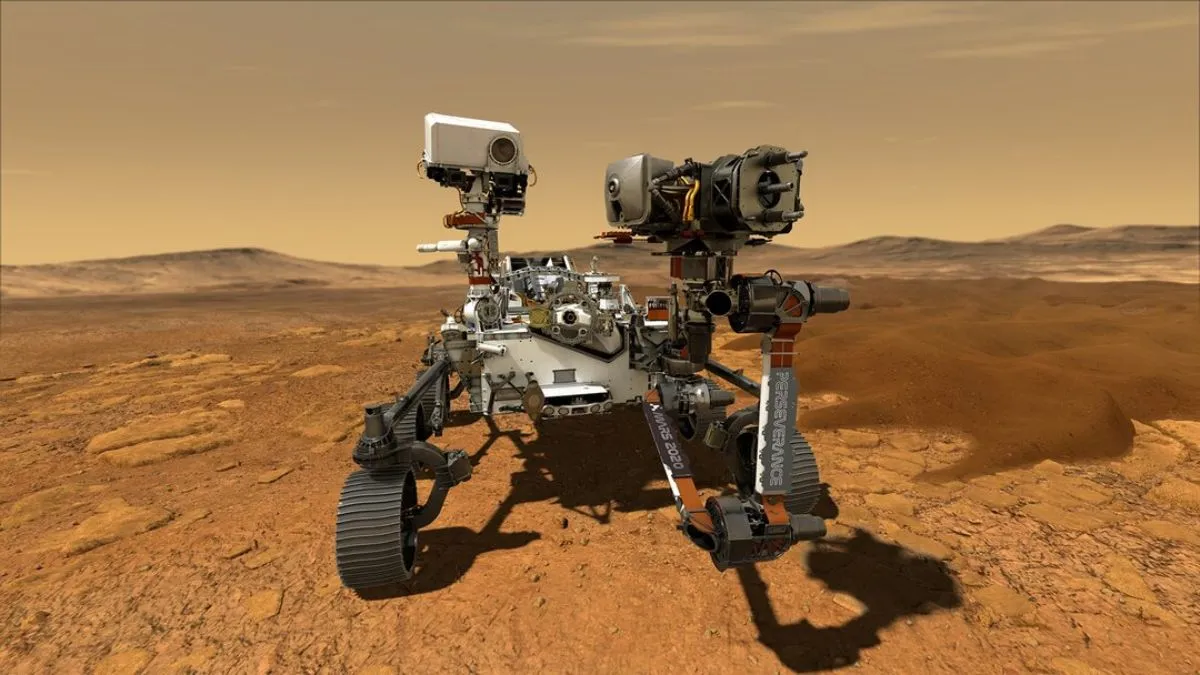
NASA has confirmed a milestone in planetary science, the first direct evidence of electrical discharges on Mars. The Perseverance rover, stationed in the Jezero Crater since 2021, has detected what scientists are calling “mini-lightning”, faint but unmistakable sparks produced during intense Martian dust storms.
For decades, lightning on Mars remained a scientific curiosity, often debated but never proven. The new findings, published in Nature, reveal 55 separate electrical discharge events captured over two Martian years through the rover’s SuperCam microphone and electromagnetic sensors.
How Lightning Forms Without Clouds
Mars is often described as eerily quiet. That silence was broken when Perseverance picked up sharp crackling noises, whip-like snaps accompanied by faint shockwaves. Scientists say these tiny bursts of energy lasted just milliseconds but carried enough signature to confirm electrical activity.
Most discharges occurred during fast-moving dust devils and storm fronts, which dominate Mars’ dry, thin atmosphere. The rover captured seven clear ‘blip-and-ring’ episodes — the closest Martian equivalent to thunder.
Unlike Earth, Mars lacks moisture-rich clouds that trigger traditional lightning. Instead, dust particles crashing into one another produce static charges through the triboelectric effect. In strong winds, these charges accumulate rapidly and release as sparks just a few centimetres long. Researchers say the planet’s carbon-dioxide-rich, low-pressure atmosphere makes it easier for sparks to form compared to Earth’s deserts.
Recommended For You
Lead scientist Baptiste Chide called the discovery “a major step in understanding Martian atmospheric chemistry and climate.” The sparks could influence how dust moves across the planet, potentially affecting temperature patterns, storm behaviour, and instrument safety. Although these discharges are far weaker than Earth’s lightning, some measuring as low as 0.1 nanojoules, they could still pose risks to sensitive electronics on future robotic or human missions.
What This Means For Mars Exploration
The team analysed 28 hours of recordings to isolate the faint electrical signals from wind noise and dust impacts. Follow-up lab tests on replica instruments confirmed that the signatures match electrostatic sparks rather than mechanical interference. Cardiff University physicist Daniel Mitchard, who was not involved in the project, noted that the findings are persuasive but warrant further verification from future missions.
ALSO READ: Will Asteroid 2024 YR4 Collide With The Moon? Here’s What NASA Has Confirmed So Far
The discovery comes at a time when scientists are exploring whether ancient lightning might have played a role in sparking chemical reactions on Mars, similar to theories about Earth’s early life. Perseverance continues its mission at Witch Hazel Hill, studying ancient river channels, volcanic remnants, and now, atmospheric electricity. With more than 30 hours of recorded Martian audio, the rover has opened a new frontier in planetary exploration.