
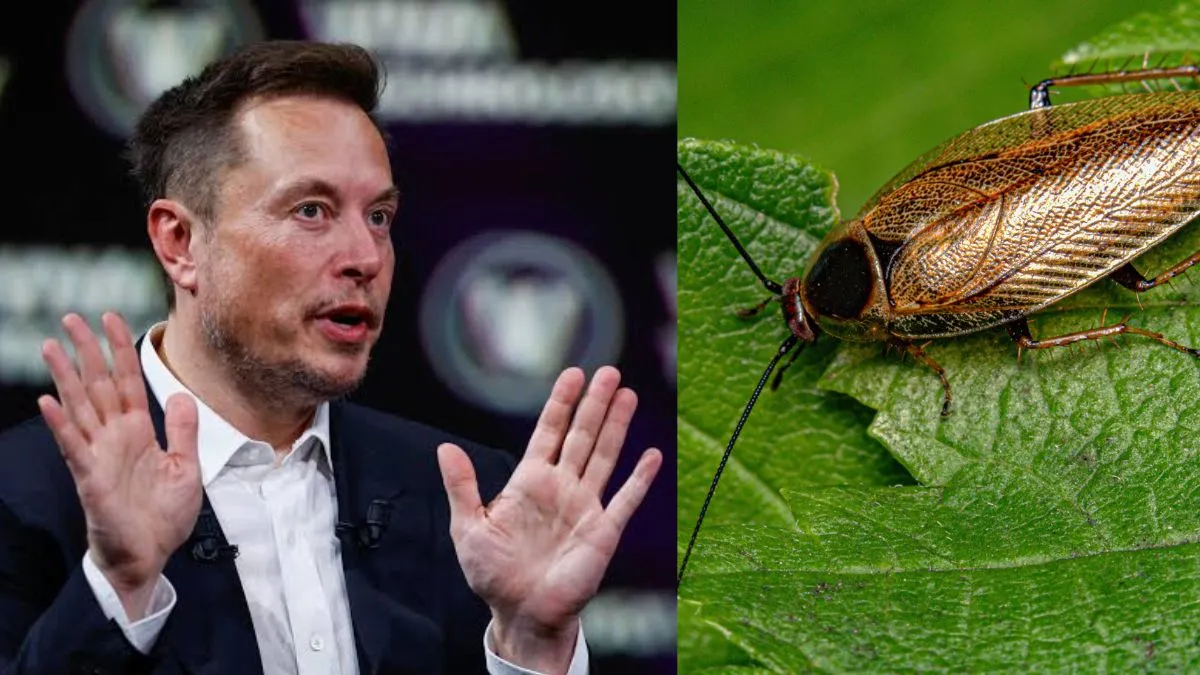
- Scientists studying Pacific beetle cockroach secretion for future food.
- Nutrient-rich crystals extracted from cockroach embryos are highly dense.
- Elon Musk called the unusual cockroach milk concept 'Gross'.
Imagine getting milk not from a cow or a buffalo, but from a cockroach. The idea may sound hard to digest, but scientists are studying a nutrient-rich secretion produced by the Pacific beetle cockroach for its potential use in future food products.
The unusual substance, popularly called cockroach milk, has drawn attention for its concentrated nutritional content. However, what makes the prospect even more surprising is how researchers obtain it: by extracting protein crystals from the developing embryos of pregnant cockroaches.
The subject has come to the spotlight after the New York Post reported on the research on October 30. Elon Musk also reacted to the report with a one-word comment: "Gross".
Cockroach Milk Is Not Actually Milk
According to the New York Post, the liquid is developed by female Pacific beetle cockroaches (Diploptera punctata) to feed their babies. Unlike normal milk, the drink is a secretion that the embryo drinks during its gestation period inside its mother.
As the embryo digests it, the secretion produces protein crystals in the gut of the developing embryos. The crystals represent protein, fats and sugars, allowing nutrients to be stored in a dense form.
In a study published in 2016, scientists reported that one crystal packs more than three times the energy of the same weight of dairy milk. This unusual ability to store nutrients has made the crystals a subject of scientific research.
Recommended For You
The Extraction Process Is What Makes It Unusual
Researchers cannot simply collect the substance as they would milk from conventional dairy animals. The process involves studying pregnant Pacific beetle cockroaches, removing their developing embryos and opening them to retrieve the protein crystals.
The method is labour-intensive, making it difficult to imagine producing the substance in large quantities through conventional extraction.
Scientists are examining the molecular structure of the crystals to understand how they form and whether their properties could eventually be reproduced through alternative methods.
Could Cockroach Milk Become A Food Ingredient?
The scientists are now considering if cockroach milk nutrients could be used in food products such as protein-rich compounds and beverages.
In 2026, a review article in the journal Insects studied whether insect food ingredients could be incorporated into beverages like tea and protein shakes. This research does not, however, imply that cockroach milk has been adopted for use in commercial products.
Its production, food safety, nutritional assessment and consumer acceptance remain important challenges. The substance is still experimental and is not an established food product.
ALSO READ: Can Human Urine Really Melt Everest's Glaciers? Here's What Scientists Say
Elon Musk's One-Word Reaction
The unusual food prospect also caught Elon Musk's attention after the New York Post published its report. Responding to the report on October 30, the billionaire entrepreneur wrote: "Gross".
His brief reaction added another layer to the online discussion surrounding the idea of consuming a cockroach-derived ingredient. While researchers are examining its nutritional possibilities, convincing consumers to accept it could prove a challenge of its own.
You May Also Like To Watch: