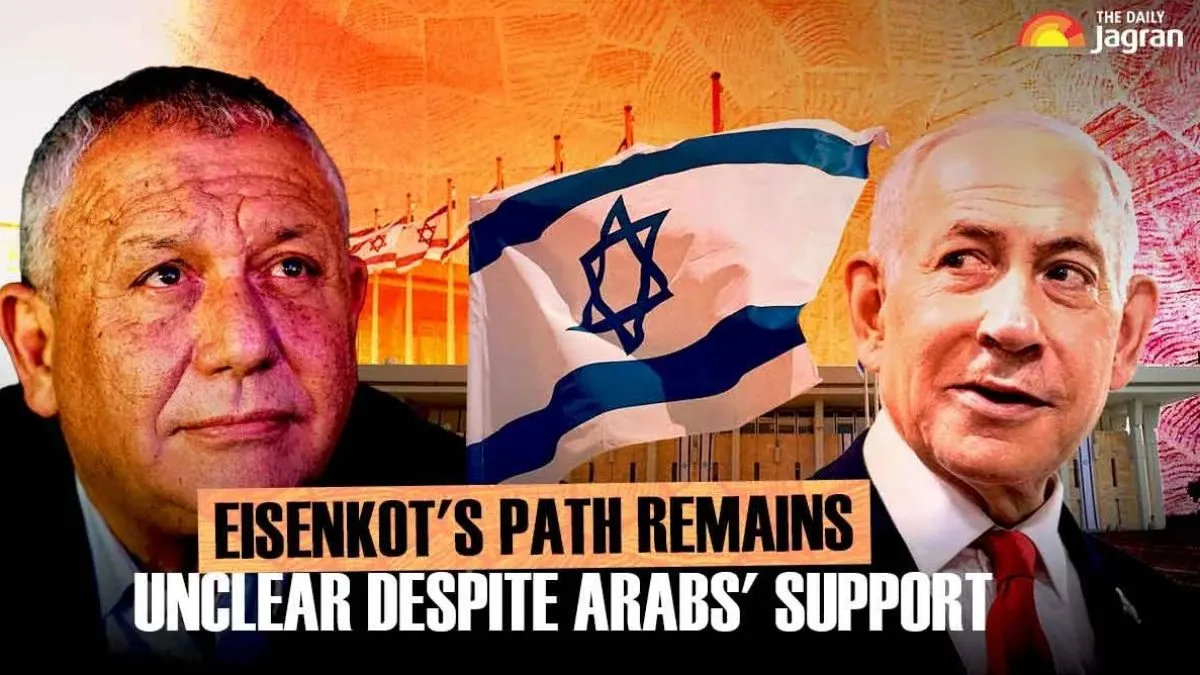
- Yashar Party leader Gadi Eisenkot backed by 67 lawmakers for Israeli Prime Minister.
- Arab parties' support creates coalition formation challenges.
- President Isaac Herzog to decide on mandate by Sunday.
Israel Government Formation: After two Arab-led parties backed Yashar leader Gadi Eisenkot to become Israel's next prime minister on Thursday, the path for the formation of the next Israeli government appears to be gaining momentum. However, despite securing the backing of 67 lawmakers, Eisenkot still faces a major political hurdle as several parties supporting him are unwilling to sit in a coalition with the Arab factions.
67 Knesset Members Back Eisenkot Over Netanyahu
Following consultations with political parties, President Isaac Herzog announced that factions representing 67 lawmakers had recommended Eisenkot for prime minister, compared with 46 lawmakers who backed Netanyahu. As the backing gives Eisenkot a clear numerical advantage over Netanyahu, Yashar party has urged Herzog to assign him the mandate without delay.
However, Herzog has not yet formally handed Eisenkot the task of forming a government. While he described the outcome as clear, Herzog said he would hold additional discussions with party leaders before making his decision on Sunday, The Times of Israel reported.
Recommended For You
VIDEO | Jerusalem, Israel: Arab-Israeli leader of the Raam list, Mansour Abbas, on Thursday, endorsed Gadi Eisenkot to form a new government on the second day of consultations with President Isaac Herzog in Jerusalem. The Raam list party had secured eight seats in the Israeli election in which neither party could secure a majority. (Source: GPO Israel) (Full video available on PTI Videos - https://t.co/bIyFWTfmBd)
— Press Trust of India (@PTI_News) November 5, 2026
ALSO READ: Netanyahu Faces Political Setback As Arab Parties Support Eisenkot To Lead Israel's Next Government
Coalition Support Remains Unclear
A key part of Eisenkot's support comes from two Arab-led parties, including Ra'am and The Joint List, which together hold 19 seats in the Knesset. They have joined four Jewish-led opposition parties, bringing the combined support for Eisenkot to 67 lawmakers. However, the opposition seems to be far from unity when it comes to forming a government.
The four Jewish-led parties (Yashar, Beyachad, The Democrats, and Yisrael Beytenu) in opposition account for 48 seats, while the two Arab-led parties hold the remaining 19. While all six factions have recommended Eisenkot for PM, three of the Jewish-led parties have so far ruled out joining a government that includes the Arab parties.
This simply creates a major contradiction in Eisenkot's bid for power. Meanwhile, another development that is likely to improve Eisenkot's chances is a change in position by Yisrael Beytenu leader Avigdor Liberman. According to Channel 12, he has indicated that he is willing to reconsider his longstanding refusal to partner with ultra-Orthodox Haredi parties.
United Torah Judaism (UTJ), which holds seven seats, has not recommended Netanyahu during the consultations. This is significant as they are part of his outgoing governing coalition. The situation has also created the possibility that the party could support an alternative political arrangement.
Mansour Abbas Faces Questions
Another potential obstacle to Eisenkot's coalition-building efforts emerged during Ra'am leader Mansour Abbas's meeting with Herzog. According to The Times of Israel, he stopped short of explicitly recognising Hamas as a terrorist organisation. The matter is significant as Eisenkot has made recognition of Hamas as a terrorist organisation one of the conditions for parties seeking to join his proposed government.
What Happens Next?
Meanwhile, Netanyahu's outgoing coalition, which secured 53 seats in the recent election continues to face setbacks as UTJ refused to recommend him for PM. Herzog is expected to announce his decision on Sunday Once a candidate receives the mandate, they will have 28 days to put together a governing coalition. If the candidate fails to secure the required support, the president can assign the task to another lawmaker.
You May Also Like To Watch: