
- India warns Pakistan against nuclear threats at UN.
- Reaffirms Jammu and Kashmir as integral part of India.
- India warned it will not bow to nuclear blackmail.
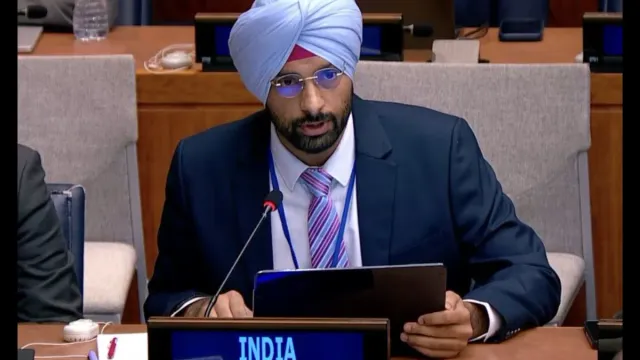
India on Friday delivered a strong response to Pakistan at the United Nations General Assembly's First Committee, warning that nuclear weapons must not be used as tools to threaten other countries. India firmly stated that it will not bow to nuclear blackmail and that its defence capabilities are shaped by its security needs. The response came after Pakistan raised the issue of Jammu and Kashmir during a meeting on disarmament and international security.
India Reaffirms Its Stand On J-K
Exercising India's right of reply, Anmol Sher Singh Bedi, Senior Adviser (Disarmament) at India's Permanent Mission to the Conference on Disarmament in Geneva, rejected Pakistan's claims on Jammu and Kashmir. Bedi said the Union Territory is an integral and inalienable part of India. He also stressed that India has always supported peace but warned that a lack of accountability for reckless actions continues to create tensions in the region.
At the ongoing #UNGA81 First Committee session, I exercised India’s right of reply in response to Pakistan’s remarks, underlining that: “Escalation concerns are best judged by conduct, not rhetoric. A posture that relies on a nuclear overhang to promote sub-conventional adventurism only raises the risk of escalation, not the prospect of restraint.”
— Anmol Sher Bedi (@bedi_sher) October 9, 2026
ALSO READ: India Calls Out Pakistan's Double Standards On Terrorism With Masood Azhar Question At UN
"India has always stood for peace and continues to seek peace with one and with all. However, if there is no accountability for reckless actions, then peace rarely becomes a pause between crises," Bedi said. He added that concerns about escalation should be judged by a country's actions over time, rather than its statements.
India Warns Against Nuclear Blackmail
Bedi further opposed the use of nuclear threats to limit India’s response to terrorism. He said that using non-state actors to carry out attacks does not free a state from responsibility. Outlining India’s position, he said, “First, any terrorist attack against India will receive a fitting response. Second, India will not bow to nuclear blackmail. Third, India will make no distinction between those who sponsor terrorism and those who mastermind it.”
Bedi also said India's defence capabilities are defensive in nature and are not directed against any country. "Nuclear weapons must not be treated as 'routine instruments of statecraft'," he added. He further warned that relying on nuclear threats to shield cross-border or sub-conventional activities could increase the risk of escalation instead of promoting peace.
Referring to Operation Sindoor, Bedi said India's actions in May last year followed the Pahalgam terror attack, which killed 26 civilians on April 22. He described India's response as "measured, targeted, and designed to be non-escalatory." Bedi also addressed the Indus Waters Treaty, stating that trust and cooperation were essential to the agreement.
You May Also Like To Watch: