
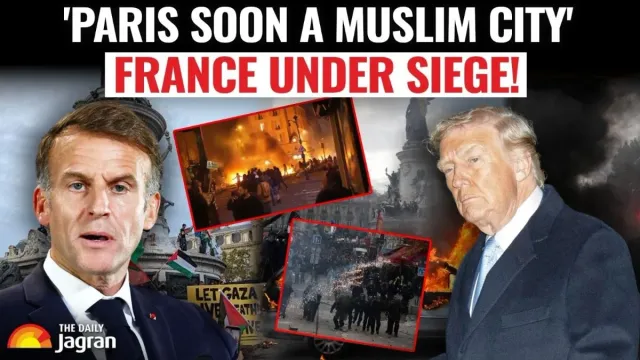
- Trump blames French unrest on immigration, Muslim religion.
- Urges Macron to tighten borders, warns Paris demographics.
- Demographic data does not support 'Muslim city' claim.
US President Donald Trump has once again blamed immigration and the "Muslim religion" for the unrest in France, urging French President Emmanuel Macron to tighten border controls. Speaking to reporters in Washington on Monday, Trump dismissed explanations centred on school conditions and other domestic issues, insisting that immigration was the primary cause of the protests.
"What's happening in France has to do with immigration, not schools, not anything," he said, claiming he had advised Macron to close France’s borders years ago. Trump also warned that Paris would soon become a "Muslim city", linking the French capital’s changing demographics to the country's immigration policies.
This is not the first time Trump has attributed social unrest in Western countries to immigration. His remarks come amid protests across France over rising living costs and concerns about public services and education, with some demonstrations escalating into violence and looting. French authorities have not established a link between immigrants as a group and the unrest. Trump’s comments have also drawn attention to the wider political debate over immigration, national identity and integration, particularly in the run-up to the US midterm elections.
Recommended For You
But two key questions remain: Why did Trump claim that Paris could soon become a "Muslim city"? And what do France’s demographic data actually reveal about the religious composition of Paris and the possibility of any one community becoming the majority?
First, what’s happening in France?
France saw some of the worst unrest in years at the weekend as huge protests across the country over the cost of living and underfunded public services descended into riots and looting. Limoges town hall was torched, and more than 3,000 shops were pillaged or damaged, according to the government, as violent groups clashed with police in cities across the country.
Trump, however, attributed the turmoil primarily to immigration, turning the French unrest into an argument for his hardline border policies. Trump's prediction about Paris becoming a “Muslim city” is a political assertion, not an established demographic fact. His remarks also do not establish that Muslims or immigrants as a group were responsible for the violence.
Religion-wise demographics of France and Paris
France has a religiously diverse population, but official religion-wise population figures are limited because the French census does not routinely ask people about their religion. As a result, estimates come mainly from surveys rather than a complete count of every resident.
No religion: 51 per cent-- the largest category.
Catholic: 29 per cent-- the largest religious affiliation.
Muslim: 10 per cent-- the second-largest religious affiliation.
Other Christians: 9 per cent, including Protestant and Orthodox Christians.
Other religions: Approximately 1 per cent in the survey's published summary
It is also important to distinguish France as a whole, the City of Paris, and the wider Paris metropolitan region. Their demographic profiles are not identical.
Is Paris becoming a Muslim-majority city?
The available data do not establish that Paris is Muslim-majority or that it is on course to become so. France's census does not count residents by religion, and there is no reliable, current, comprehensive religion-wise census for Paris that supports such a conclusion.
The most defensible comparison is to use the 2019–2020 national survey for France and clearly dated, geographically specific surveys for Paris, rather than combining estimates from different years and areas.
(With inputs from Reuters)
You may also like to watch