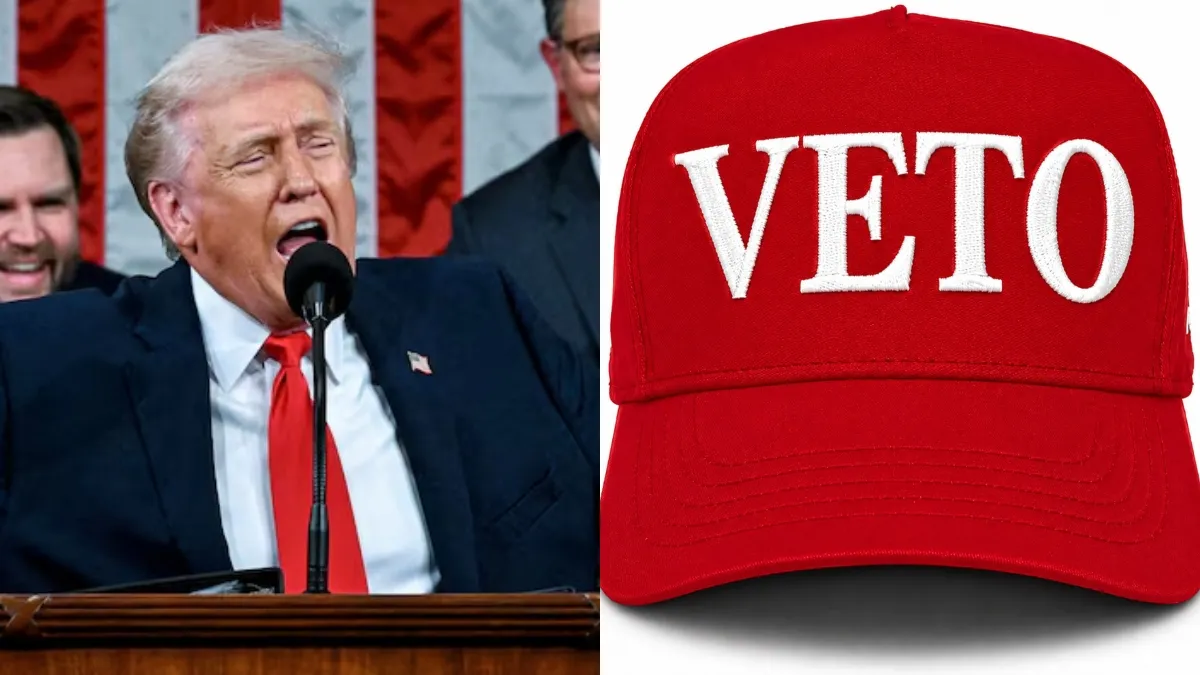
- Trump declared himself 'Mr. Veto' after midterm losses.
- Veto power crucial for blocking legislation post-GOP majority.
- Congressional override possible with two-thirds majority vote.
As US President Donald Trump loses legislative control with midterm setbacks in both the House of Representatives and Senate, 'Veto' has emerged as one of the most discussed topics in American politics.
In a Truth Social post, Trump shared a red hat with 'Veto' written on it. The post came after Trump, in a telephone interview with CBS, said that he would be Mr Veto. "I guess I'll become Mr Veto… And then at some point, we'll probably make deals," he told the New York Post's Pod Force One podcast.
Speaking about this new division of power, Trump said, "As you know, this has happened many times before. This is the power of the veto, and it's one of the greatest powers a president has. They'll pass some ridiculous things through Congress, and I'll veto them."
What does the midterm result mean for Trump and what is a veto?
After losing the majority in both the Senate and the House, Trump will face limitations in pushing Republican legislation through and would have to rely on Democrats' support. Besides, the new setup would make it difficult for Republicans to restrict Democrats-pushed legislation.
Recommended For You
The only way Trump could override the Democratic majority for key bills is through the President's exclusive 'Veto' power.
It is a key constitutional power of the President under Articles 1 and 2 of the United States Constitution, allowing him to prevent any bill passed by Congress from becoming law. Although the word 'Veto' itself is not mentioned in the clauses. If he objects to any legislation, he must send it back to the chamber where it originated. He can also leave a bill unsigned, which is called a 'pocket veto'.
If Congress remains in session for 10 days, the unsigned bill becomes a law; otherwise, it dies.
However, according to the US legislative system, the President's veto is not absolutely final; if both houses of the US Congress, the House of Representatives and the Senate, again pass the bill by a two-thirds majority, the President's veto becomes ineffective, and the bill becomes law even without the President's signature, as was seen in the case of the Defence Bill during Trump's last tenure.