
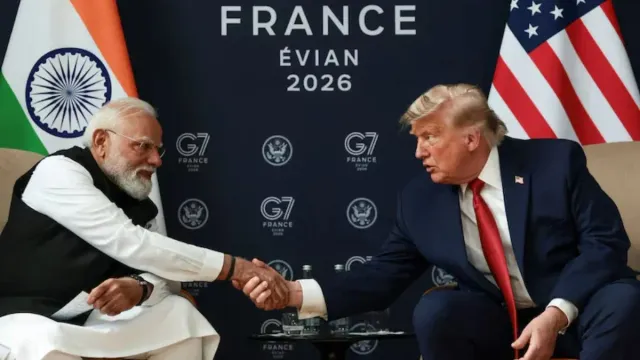
- Trump reversed Russian oil sanctions, easing pressure on India.
- US midterm elections, economic woes influenced policy shift.
- Rubio's Jamnagar visit signals India's strategic energy role.
Last week witnessed one of the most significant policy U-turns by US President Donald Trump in recent times, as Washington announced a major diesel deal with Russia and waived sanctions targeting countries such as India and China for purchasing Russian oil. The decision marks a striking shift in an administration that has repeatedly used sanctions as a tool to pressure Moscow and its energy partners.
Geopolitical experts dubbed Trump’s move a "breathing room" for the Republican Party as it is facing extensive criticism from its own party for negotiating with Russian President Vladimir Putin at a time when Ukraine needs its American partner. The upcoming visit of Secretary of State Marco Rubio to Jamnagar, Gujarat, is an apt example to gauge Trump's desperation for Russian energy via India. Notably, Jamnagar hosts Reliance's biggest oil refinery, and this could be one of the reasons why Rubio skipped New Delhi, which is a hotspot of India's power centre.
Why Trump needs India before midterms
Coming amid mounting domestic political pressure and with the US midterm elections just two weeks away, the move raises questions about the motivations behind Washington’s sudden change of course. Rather than viewing it solely through a geopolitical lens or as a gesture of goodwill towards countries such as India and China, the decision must also be examined in the context of America’s economic challenges.
Recommended For You
ALSO READ: Did Trump Waive Russian Sanctions Due To India-US Trade Deal? What Rubio Said
With oil prices climbing to a six-month high and inflation remaining a politically sensitive issue, easing pressure on energy supplies could help the Trump administration contain fuel costs and blunt criticism from voters. The timing suggests that domestic economic considerations may have played a significant role in this policy reversal, offering the Republicans potential breathing room at a crucial electoral moment.
Only India can provide breathing room to America
The US decision to ease Russian sanctions affecting India should not automatically be interpreted as a gesture of goodwill towards New Delhi. Beneath the language of diplomatic flexibility lies a more complicated calculation involving energy markets, geopolitical interests and domestic political pressures facing President Trump ahead of the US midterm elections.
ALSO READ: Rubio's India Visit: Washington Must Learn To Engage New Delhi On Its Own Terms
For Washington, India occupies a strategically important position in the Indo-Pacific. As a major economy and an influential regional power, New Delhi remains central to American efforts to counterbalance China. At the same time, India’s continued energy engagement with Russia has exposed the limits of Washington’s ability to dictate the choices of its partners through sanctions and diplomatic pressure.
Is it a fundamental shift in American policy?
The waiver, therefore, can be viewed as a pragmatic adjustment rather than a fundamental shift in American policy. Attempting to pressure India too aggressively over Russian oil could strain bilateral relations, complicate broader strategic cooperation and contribute to volatility in global energy markets. In that sense, flexibility serves American interests as much as it offers India temporary relief.
However, the domestic political context cannot be ignored. With the midterm elections approaching, economic stability and fuel prices could become politically sensitive issues for the Trump administration. Higher energy costs can feed inflation, weaken consumer confidence and create an opening for political opponents to criticise the government's economic management. Any measure that helps contain energy-market disruptions could provide the administration with valuable breathing room.
This does not necessarily mean that the waiver was designed exclusively to improve Trump's electoral prospects. Foreign policy decisions rarely have a single motivation. Nevertheless, the possibility that domestic political considerations influenced Washington's calculations deserves scrutiny, particularly when sanctions policy intersects with global oil supplies and consumer prices.
(With inputs from Reuters)