

- By Ajeet Kumar
- Fri, 27 Feb 2026 04:40 PM (IST)
- Source:JND
- Pakistan launched airstrikes on Afghanistan over escalating border clashes.
- Historical allies now at odds over TTP militant safe havens.
- Pakistan's past militant policies led to current security crisis.
Pakistan has been the Afghan Taliban’s closest friend for decades. It was Islamabad that helped give birth to the Taliban in the early 1990s as a way to give Pakistan "strategic depth" in its rivalry with India. What has gone wrong?
Pakistan carried out air strikes on Afghanistan's major cities overnight, officials in Islamabad and Kabul said on Friday, escalating months of border clashes between the Islamic neighbours.
The air and ground strikes, which hit Taliban military posts, headquarters and ammunition depots in multiple sectors along the border, came after Afghanistan launched an attack on Pakistani border forces, the officials said.
Both sides reported heavy losses in the fighting, which Pakistan's defence minister said amounted to an "open war".
The escalating conflict is a long way from Islamabad’s historic support for the Taliban. The key questions:
Why are the neighbours now at odds?
Pakistan welcomed the return to power of the Taliban in 2021, with then Prime Minister Imran Khan saying that Afghans had "broken the shackles of slavery".
But Islamabad soon found that the Taliban were not as cooperative as it had hoped.
Islamabad says that the leadership of militant group Tehreek-e-Taliban Pakistan (TTP) and many of its fighters are based in Afghanistan, and that armed insurgents seeking independence for the southwestern Pakistani province of Balochistan also use Afghanistan as a safe haven.
Militancy has increased every year since 2022, with attacks by the TTP and Baloch insurgents growing, according to Armed Conflict Location and Event Data, a global monitoring organisation.
Kabul, for its part, has repeatedly denied allowing militants to use Afghan territory to launch attacks in Pakistan. The Afghan Taliban say Pakistan harbours fighters from its enemy, the Islamic State, a charge Islamabad denies.
Who are the Pakistani Taliban?
The TTP was formed in 2007 by several militant outfits active in northwest Pakistan. It is commonly known as the Pakistani Taliban.
The TTP has attacked markets, mosques, airports, military bases and police stations, and has gained territory mostly along the border with Afghanistan, but also deep inside Pakistan, including the Swat Valley. The group was behind the 2012 attack on then schoolgirl Malala Yousafzai, who received the Nobel Peace Prize two years later.
The TTP also fought alongside the Afghan Taliban against US-led forces in Afghanistan and hosted Afghan fighters in Pakistan. Pakistan has launched military operations against the TTP on its own soil with limited success, although an offensive that ended in 2016 drastically reduced attacks until a few years ago.
Is Pakistan reaping what it sowed?
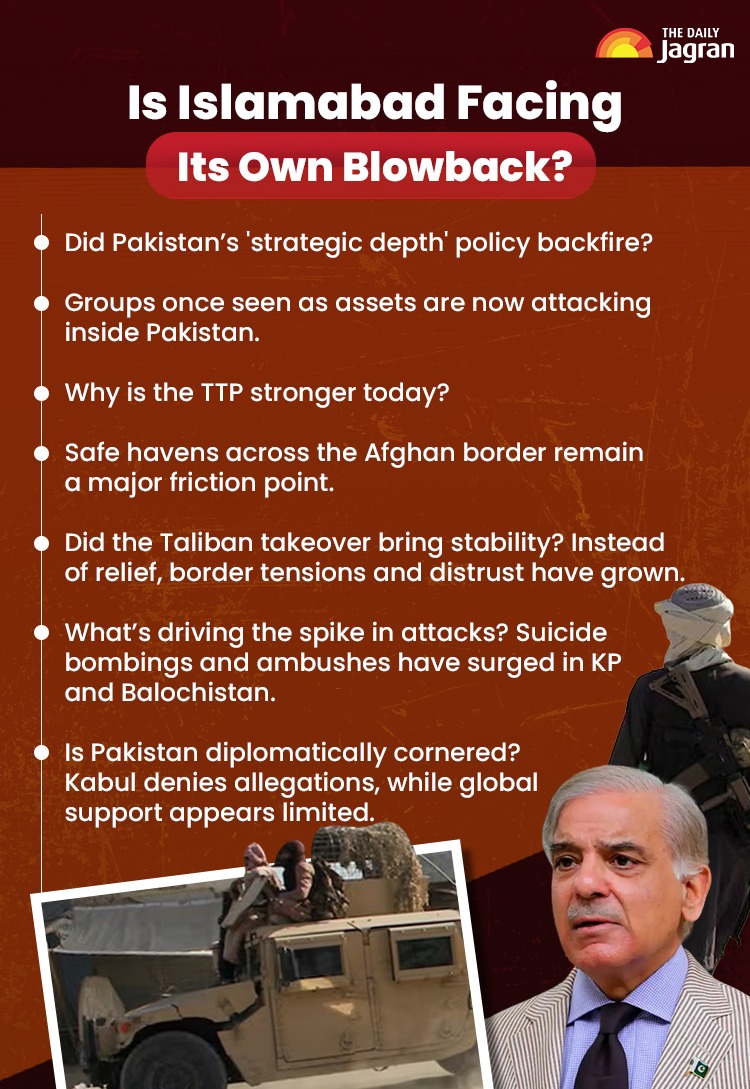
1. Blowback from militant policies: Pakistan’s long-standing strategy of backing certain militant groups for “strategic depth” in Afghanistan has backfired, with factions like the TTP now targeting the Pakistani state itself.
2. Safe havens turned against it: For years, armed groups operated from border regions. Today, cross-border militancy and attacks inside Khyber Pakhtunkhwa and Balochistan are the direct consequences of that policy.
3. Strained ties with the Taliban govt: Islamabad once hoped the Afghan Taliban’s return to power would ensure security. Instead, tensions over border fencing, the Durand Line, and militant sanctuaries have worsened relations.
4. Internal security crisis deepens: A surge in suicide attacks and assaults on security forces shows that instability nurtured externally has now become an internal nightmare.
5. Diplomatic isolation growing: Frequent border clashes and accusations have weakened Pakistan’s regional standing, as Kabul rejects Islamabad’s claims and global patience wears thin.
(With inputs from Reuters)