
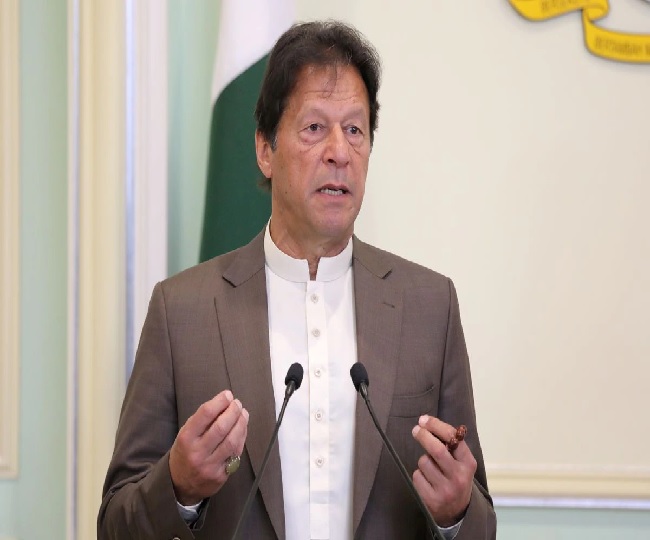
Islamabad/ New Delhi | Jagran News Desk: Pakistan is once again going through a political crisis after a no-confidence motion against Prime Minister Imran Khan and his government was rejected by Deputy Speaker Qasim Sur in the National Assembly on Sunday. Later, Imran, whose Pakistan Tehreek-e-Insaf (PTI) has lost the majority in the Parliament, advised President Arif Alvi to dissolve the National Assembly, calling out for fresh elections within 90 days.
Later on Sunday, Imran was de-notified as Prime Minister, making the political crisis worse. The 69-year-old cricketer-turned-politician came to power in 2018 and since then, he has been expressing his desire to move closer to China. Recently, he also talks with Russia's Vladimir Putin over its invasion of Ukraine.
Pakistan, with over 150 nuclear weapons, lies between India, Afghanistan, and China, making it of vital strategic importance. Here's a look at how the political crisis in Pakistan might impact India and other countries:
India:
India and Pakistan have fought three full-scale wars - 1947, 1965, and 1971 - with each other. The relationship between New Delhi and Islamabad has particularly deteriorated after India abrogated Article 370 from Jammu and Kashmir and bifurcated the state into two union territories (UTs) in 2019.
Recommended For You
Under Imran, Pakistan has also criticised India, especially Prime Minister Narendra Modi, for mob lynching incidents in the country.
However, if a new civilian government is formed in Islamabad, then it could be put under pressure by the Pakistan army to build on the successful ceasefire in Kashmir, said Indian political commentator Karan Thapar, as reported by Reuters.
Notably, Pakistan army chief General Qamar Javed Bajwa on Saturday had also said that Islamabad is ready to discuss all issues with India, including Kashmir.
China:
Imran has repeatedly expressed his desire to move closer to China, emphasising Beijing's positive role in Pakistan and in the world. The two countries have also signed the USD 60 billion China-Pakistan Economic Corridor (CPEC).
Shehbaz Sharif, the potential successor of Imran, has struck deals with China directly as leader of the eastern province of Punjab, and his reputation for getting major infrastructure projects off the ground while avoiding political grandstanding could in fact be music to Beijing's ears.
US:
The United States (US) was once an important ally of Pakistan. However, regional experts believe that the current crisis is unlikely to be a priority for President Joe Biden, who is currently dealing with the Russian-Ukraine war.
They say that unless the crisis leads to massive unrest or a spike in tensions with India, Biden won't give attention to Pakistan.
"Since it's the military that calls the shots on the policies that the U.S. really cares about, i.e. Afghanistan, India and nuclear weapons, internal Pakistani political developments are largely irrelevant for the US," Reuters quoted Lisa Curtis, who served as Donald Trump's National Security Council senior director for South Asia, as saying.
Afghanistan:
Pakistan has always been supportive of the Taliban regime in Afghanistan and is known for its close ties with the Islamic group. However, ties between Pakistan and the Taliban loosened over the past few months due to differences over the Durand Line.
Pakistan is also worried about the Taliban's rise might also allow the other extremist groups in the region to grow under its shadow. "We (the United States) don't need Pakistan as a conduit to the Taliban. Qatar is definitely playing that role now," said Curtis, as reported by Reuters.