
- By Shivangi Sharma
- Sun, 13 Oct 2024 06:47 PM (IST)
- Source:JND
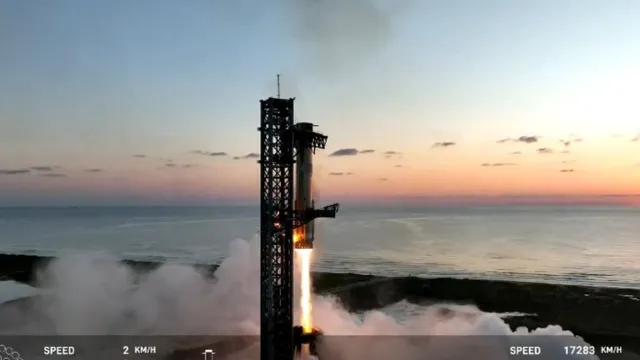
SpaceX on Sunday conducted its most ambitious test flight to date with the launch of its massive Starship rocket, successfully catching the returning booster at the launch pad using mechanical arms.
Standing nearly 400 feet (121 meters) tall, the uncrewed Starship took off at sunrise from the southern tip of Texas, close to the Mexican border.
It followed a trajectory over the Gulf of Mexico, similar to the previous four Starships, which were destroyed shortly after launch or during their ocean landings.
The Super Heavy booster successfully reached the arms of Mechazilla, SpaceX’s launch tower.
Mechazilla has caught the Super Heavy booster! pic.twitter.com/6R5YatSVJX
— SpaceX (@SpaceX) October 13, 2024
The Super Heavy rocket booster has ignited its 33 engines and is launching into space with the Starship spacecraft positioned on top.
This test flight of the Starship lasted around one hour in total, but the highlight of the day was the landing of the Super Heavy booster back at the launch site that occurred just seven minutes after takeoff.
Successfully landing the booster enhances its potential for quick reusability, thereby lowering the expenses associated with space travel.
Half of the Starship rocket system is now back on Earth, with the Super Heavy booster proudly resting at its designated landing area. Meanwhile, the Starship spacecraft continues its journey through space.
Earlier today, SpaceX announced that the return of the Super Heavy rocket booster to Earth will introduce a new feature for the fifth test flight: loud sonic booms.
The company explained that this "unique aspect" will occur because the vehicle will be travelling faster than the speed of sound, creating a ripple of noise across the landscape.
While previous test flights have produced sonic booms of varying volumes, SpaceX anticipates that the booms from this booster return could be more powerful.