
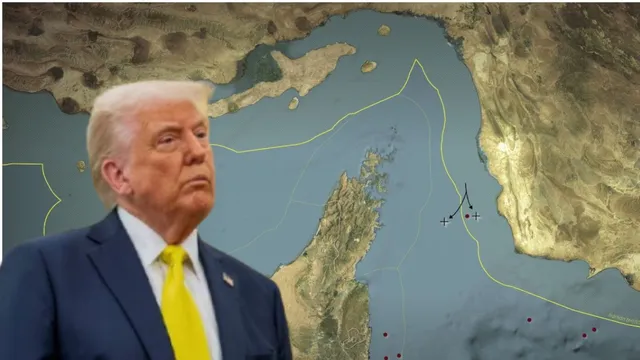
- Trump claims US will 'take over' Strait of Hormuz.
- Proposes 20% transit fee for all cargo ships.
- US to be 'Guardian Angel' of the crucial waterway.
United States President Donald Trump on Monday made a shocking claim of 'taking over' the Strait of Hormuz as 'Guardian Angel of the Strait' and possibly charging a fee on wealthy nations in future.
Speaking to "Fox & Friends", the US President said, "We're taking over the strait. They've got nothing." He also asserted that Hormuz closure remained a threat from Iran for 47 years and that the US should have addressed it "47 years ago."
Pinning blame for the negotiations falling apart on Iran, Trump said that leaders from Tehran participated in an 11-hour round of negotiations and "everything was agreed to" before they started asking for changes.
"We're going to keep the strait, and we'll probably run it. We'll become the guardian of the strait. Maybe we'll call it the guardian angel of the strait. And we should be reimbursed for that," he said.
He emphasised that the US was guarding the crucial waterway for nothing until now, indicating a plan to charge for the security. "We're going to get paid for guarding it. A lot of money, but we just want to be reimbursed for doing all of this, for putting our people in danger," he said in the interview.
Doubling down on his claim, Trump also announced the rate of transit fee. He said that all ships will have to pay 20 per cent of their cargo. In a post on Truth Social, he said, "The USA will be, from this point forward, known as “THE GUARDIAN OF THE HORMUZ STRAIT,” but as such, and as a matter of FAIRNESS, will be reimbursed, at the rate of 20% on all cargo shipped, for any and all costs necessary to do the job of providing safety and security to this very volatile section of the World. The process and formation will begin immediately."
Recommended For You
Trump's payment arrangement vs Iran's transit fee
Trump's remarks on charging nations for safe transit contradict its stance on the freedom of navigation, which in effect, was cited by Washington to oppose a similar arrangement announced by Iran months ago.
Notably, Iran first announced it was considering levying transit fees on March 19, 20 days into the war. Within days, reports surfaced it had started charging some commercial vessels on an ad hoc basis, with fees reportedly reaching up to $2 million per voyage, a claim that remained unsubstantiated.
A significant development in this direction came on May 18, when Iran formally launched the Persian Gulf Strait Authority (PGSA), creating an official system requiring ships to obtain permits and pay transit fees before passing through the Strait of Hormuz.
While implementation of the fee arrangement still remains unconfirmed, Iran has time and again claimed that a PGSA permit is required to transit through the Strait.
Oman corridor and the fresh escalation
Later on June 24, Oman and the United Nations' Maritime Agency IMO formed a temporary corridor along the Omani coast to evacuate the stranded ships. The US forces are providing security to the corridor.
The formation of a new corridor has been protested by Tehran, which has insisted that the route designated by it remains the only safe passage. The latest escalation in tensions was also caused by the attacks on ships transiting through the Omani corridor.
Iran persists on closure claims
As Trump claimed control of the Strait, Tehran too persisted on its claim of closure of the narrow waterway. In a post on X, the Persian Gulf Strait Authority (PGSA) accused American forces in the region of its decision to effectively close the Strait of Hormuz.
The PGSA stated, "Due to recent hostile actions by the US forces, passage through the Strait of Hormuz is currently unfeasible. As soon as stability and calm are restored, all applications will be reviewed in accordance with the scheduled timeline, and the permitting process will resume."
Notably, the same statement was issued by the PGSA a day earlier, adding, "Remember that the sole means of obtaining a passage permit is via our website."