
After 40 days of continuous fighting between the US, Israel, and Iran, a temporary ceasefire has been reached. Amid the ceasefire, ongoing US-Iran peace talks in Islamabad have failed. Late Saturday night, the first round of face-to-face talks between the US and Iran on a ceasefire and de-escalation of tensions concluded. US Vice President JD Vance said on Sunday that his negotiating team was leaving Islamabad following 21 hours of talks. Vance cited shortcomings in the negotiations, saying Tehran had declined to accept American terms.
Meanwhile, from Iran's new Supreme Leader, Mojtaba Khamenei, to battle-hardened strategists and a president with limited powers, here are six key figures who are not only shaping Tehran's direction, but whose decisions could change the fate of all of West Asia.
Mojtaba Khamenei
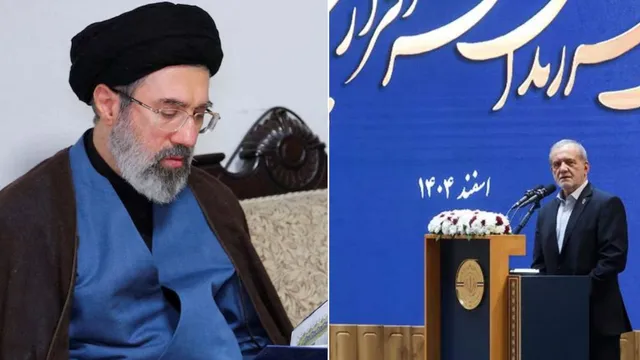
Following the death of Supreme Leader Ayatollah Ali Khamenei, Mojtaba Khamenei was appointed the new Supreme Leader. Mojtaba was not actually the successor to the Supreme Leader, as Iran had never intended to have a hereditary position. For many years, Mojtaba was known less for his speeches and more for his silence.
Recommended For You
However, those within Iran's power structure were already aware of his influence. He may not have been visible, but his presence was certainly felt. In appointments, in decisions, and in determining who would and would not be able to meet with the Supreme Leader. He has not been seen since he took over as Iran's Supreme Leader.
ALSO READ: Trump Issues Warning To China: Stop Weapons Shipments To Iran Or Face 'Big Problems'
Mohsen Rezaei
Mohsen Rezaei has devoted his life to the idea of military readiness and confrontation. A former commander in the Islamic Revolutionary Guard Corps, he comes from a generation that actively shaped the Iran-Iraq War between 1980 and 1988. Over the years, his public statements and policy positions have repeatedly reflected a preference for hardline strength rather than diplomatic compromise.
Ahmad Wahidi
Ahmad Vahidi has assumed command of the IRGC at a time when its leadership has come under attack. A series of attacks have targeted high-ranking officials within Iran's military establishment. This has presented Vahidi with a challenge few would dare to undertake: rebuilding command, maintaining morale, and responding to an enemy that has already proven its ability to strike deep.
Mohammad Bagher Ghalibaf
Mohammad Bagher Ghalibaf began his career in uniform at a young age during the Iran-Iraq War. Over time, he moved through a series of senior roles, including military command positions, leadership in the air force, and later heading the police. As police chief, he emphasised modernisation and institutional reform, while his tenure as mayor of Tehran was marked by a focus on urban development and infrastructure.
ALSO READ: ‘No Peace Deal’: JD Vance Says Leaving Pakistan After Iran Chose Not To Accept US Terms
Masoud Pezeshkian
Masoud Pezeshkian is the current and 9th President of Iran. He assumed office on 28 July 2024 after winning the July 2024 election. However, the position of president in Iran carries very little power. The presidency is not the centre of power in Iran. It operates alongside, and often subordinate to, more powerful institutions.
Abbas Araghchi
Abbas Araghchi plays a key role in a regime dominated by military and clerics. As an experienced diplomat, Araghchi also played a key role in the negotiations that led to the 2015 nuclear deal. He understands the language of the agreement.
As Foreign Minister, he operates at the forefront of perception. While others shape events on the ground, he shapes how those events are interpreted to the world.