
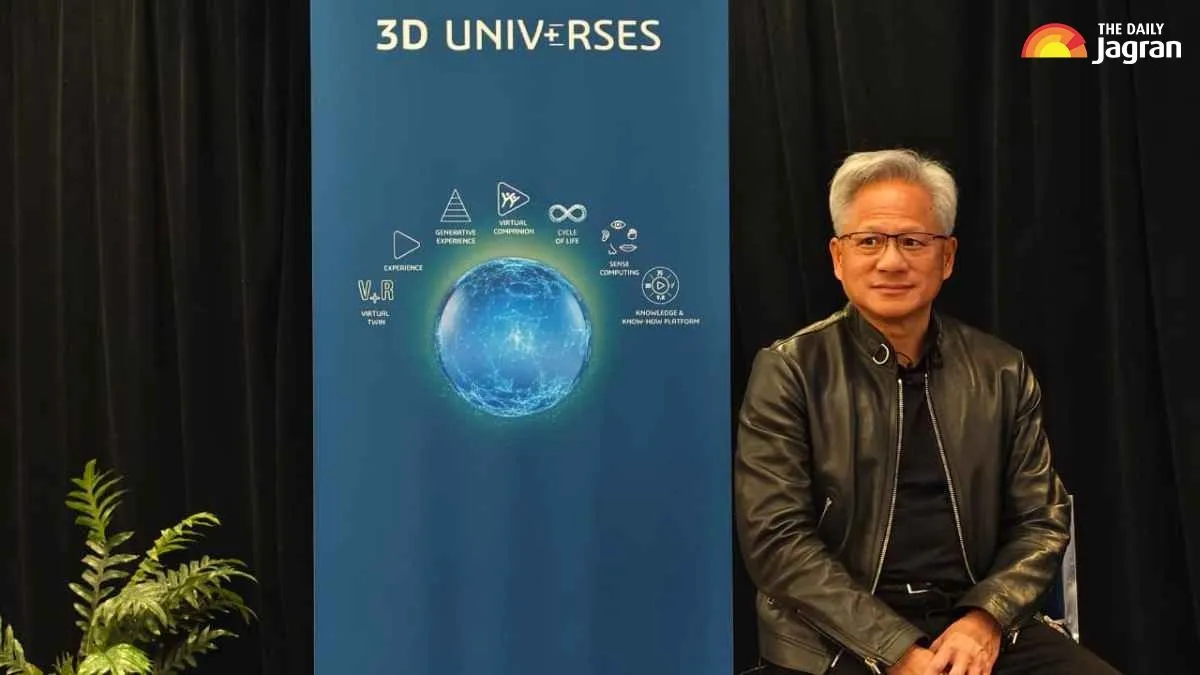
3DExperience WORLD 2026 Highlights: At the buzzing stage of 3DExperience WORLD 2026 in Houston, Jensen Huang, founder and CEO of Nvidia, said the world is moving rapidly toward software-defined vehicles, and the industry must be ready for that shift. Standing alongside Pascal Daloz, CEO, Dassault Systèmes, Huang made it clear that the future of mobility will be imagined in software long before it touches the road.
Jensen Huang also spoke candidly about his experiences taking a ride in India, calling Indian roads among the most challenging in the world. He remarked that if someone can confidently handle traffic conditions in India, they can drive anywhere globally. Sharing a personal anecdote, Huang recalled a moment from his last visit when traffic was moving so slowly that his car was progressing at almost the same speed as a person walking alongside the road.
Also Read: Crashing Cars Without Crashing Cars: How Dassault Systèmes Wants to Redefine Vehicle Safety
For him, this wasn’t criticism but a reflection of the sheer complexity, density, and unpredictability that define real-world driving conditions in the country. Huang added that these very challenges make India an important market and testing ground for future mobility technologies.
Recommended For You
Also Read: Maruti Fronx Facelift Spied For The First Time; Expected To Get AWD, Level 2 ADAS And More
He expressed confidence that autonomous driving will eventually come to India and, importantly, it will not be a one-size-fits-all solution imported from the West. Instead, autonomous systems will learn, adapt, and evolve to suit local driving behaviors, traffic patterns, and infrastructure realities. According to Huang, when self-driving technology can successfully navigate Indian roads, it would represent a major milestone for autonomous mobility worldwide.
Also Read: MG Majestor Teased Again Ahead Of February 12 Debut; Check Design, Features, And Engine
According to him, the partnership between Nvidia and Dassault is unique because it reimagines how technology is used, not just to design vehicles, but to simulate, validate, and perfect them digitally. “You’re not just building cars,” Huang noted, “you’re building world-class products in a virtual world first.”
Also Read: Volkswagen Tayron R-Line To Launch Soon: Gets Level 2 ADAS, Panoramic Sunroof, And More
With modern-day cars becoming more and more technology-forward, more specifically electric vehicles, dependency on semiconductors is on the rise. NVIDIA’s role in the automotive industry has grown far beyond graphics.
Also Read: 2027 Hyundai Creta Interior Spied: Here’s What To Expect In Terms Of Features
Its platforms now power AI-driven autonomous systems, digital cockpits, advanced driver assistance systems (ADAS), and full-scale vehicle simulations. On the other hand, Dassault Systèmes is helping auto brands improve their product lifecycle.
Also Read: Tesla Model Y Switch And Save Program: Save Up To Rs 3 Lakh On Exchanging From An ICE Vehicle
Through its virtual twin platforms, automakers can design vehicles, factories, and even supply chains in a single digital environment. Pascal Daloz reiterated that India is a particularly important market for Dassault, especially in the automotive segment, as companies accelerate EV and software-led innovation.