
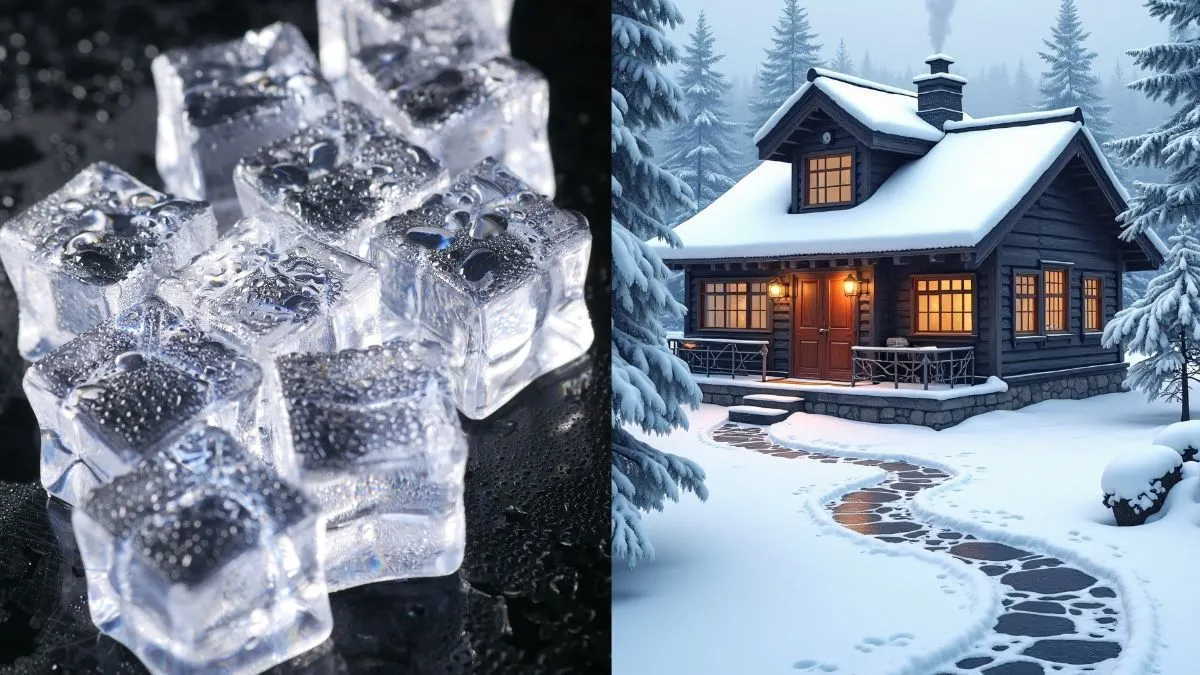
Ice and Snow Colour Difference: Have you ever wondered, Ice and snow are both made from water, but why do they look completely different? When you hold a chunk of ice, it’s typically transparent, kind of like glass, while when snowflakes fall from the sky, everything is covered in pure white, even though it is also just frozen water, as ice is. That difference might confuse kids and adults both. Why does one material show two totally distinct looks based on freezing style?
Well, the reason lies in the structure, light reflection, along how they form in nature. Snow forms high in the sky once little drops of water turn to crystals. Those crystals are fragile, packed with air spaces. Meanwhile, ice comes from water that hardens gradually into a solid block. When light strikes ice or snow, its shape, internal structure, and freezing process alter its behaviour.
To understand why ice looks clear while snow appears bright white, check how each one handles sunlight. A bit of basic physics clears up this everyday winter puzzle.
How Structure Changes Appearance
Ice turns into one solid chunk when its molecules are arranged tightly. Since freezing happens gradually and uniformly, there are fewer air bubbles. So, the light moves through the ice easily, making the ice look transparent and clear.
Recommended For You
Meanwhile, snow is made up of countless little ice crystals stuck together. Those crystals come with cracks, spaces, and pockets full of air. So, light doesn’t pass through it and bounces around instead, making it appear white due to the colour formula.
ALSO READ: 6 Viral DIY Hacks To Transform Old Blankets Into Chic Winter Must-Haves
Why Ice Appears Transparent
-1764593591781.jpg) Why ice looks transparent (Image: Canva)
Why ice looks transparent (Image: Canva)
1. When ice freezes, it forms a smooth, solid structure.
2. There are extremely few air bubbles, thus light flows straight through.
3. Light is not dispersed, which makes ice look transparent or somewhat bluish.
4. In simple words, ice operates like a clear glass window—light travels through without much interference.
Why Snow Looks White
-1764593604293.jpg) Why snow looks white (Image: Canva)
Why snow looks white (Image: Canva)
1. Snow is formed of several ice crystals, not one solid piece.
2. When light strikes these crystals, it disperses in all directions.
3. Since all hues of light scatter equally, snow appears dazzling white.
4. Snow operates like a mirror formed of small crystals—every surface reflects light, making it glitter.
ALSO READ: Kashmir Snowfall: Pir Panjal Pass Turns Into Winter Wonderland After Fresh Snowfall | Video
How Light Scattering Creates the White Colour
Light is reflected and refracted thousands of times when it comes into contact with snow. All of the light's colours are combined by this scattering. When all hues mix, we perceive white.