

- New Three-Language Policy aligns with NEP 2020.
- Two native Indian languages mandatory for students.
- Phased implementation; Class 6 faces board exams.
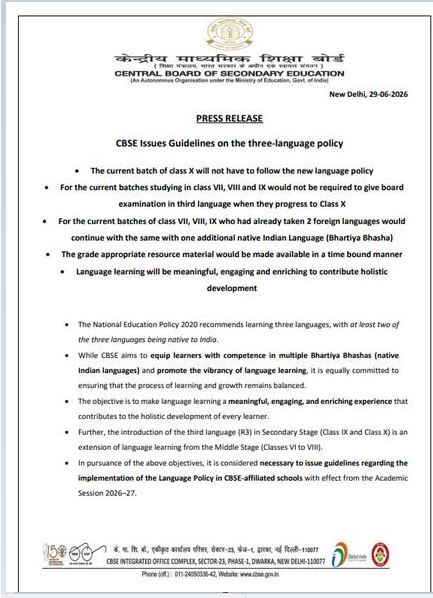
CBSE Board New R3 Policy 2026-27: The Central Board of Secondary Education (CBSE) has officially introduced revised institutional guidelines implementing the Three Language (R3) Policy across its affiliated schools. Enacted in alignment with the structural recommendations of the National Education Policy (NEP) 2020, the updated framework mandates that structural language learning must prioritize local linguistic heritage. Under this framework, students are required to study three separate languages, ensuring that at least two of the selected options qualify as native Indian languages, formally recognized as 'Bhartiya Bhashas'.
The primary administrative objective behind this strategic shift is to transform foundational language learning into a meaningful, engaging, and enriching curriculum experience that directly boosts the holistic development of every student. To maintain a smooth transition, the board has structured a phased implementation blueprint that completely immunises older batches from sudden changes while gradually building up evaluation stringency for newly entering primary classes.
How Does the Policy Affect Students in Class 9, 10 During the 2026–27 Academic Year?
The board has explicitly clarified that the transition will follow distinct rules for students currently enrolled in high school classes:
Class 10 Immunity: There is absolutely no change in curriculum requirements for the batch clearing Class X during the 2026–27 cycle. These students will continue following the traditional two-language system and are not required to take up a third language.
Recommended For You
Class 9 Structural Mandate: Every student entering Class IX in 2026–27 must adopt three languages, out of which a minimum of two must be Bhartiya Bhashas (such as Hindi, Sanskrit, Tamil, or Punjabi). Non-native choices like English, French, or German will fill the remaining slots.
Board Examination Relief: The third language (R3) for this specific Class IX batch will be evaluated solely through internal school-based assessments. No external CBSE Board examination will be administered for the third language when this cohort progresses into Class X during the 2027–28 session.
What Relaxations Are Provided to Middle School Students in Classes 7 and 8?
Specific protective guidelines protect intermediate middle school students who have already advanced significantly under old foreign language modules:
Foreign Language Continuity: For current batches sitting in Class VII and Class VIII who have already selected and commenced learning two separate non-native foreign languages, a relaxation is granted. They are permitted to continue those tracks provided they adopt one additional Bhartiya Bhasha to carry forward through Class X.
Evaluation Framework: Just like the current ninth graders, these intermediate middle school batches are fully exempted from sitting for a third-language board exam. Their performance will be tracked entirely via internal school evaluation protocols.
Why Do Class 6 Batches Face Mandatory Board Exams in New Third Language?
The board is applying the full weight of the NEP 2020 structural reforms, beginning directly with the youngest middle school bracket:
Compulsory Indian Languages: For the Class VI batch of 2026–27 and all subsequent academic cohorts, studying two native Bhartiya Bhashas out of the three-language total is strictly compulsory.
Mandatory External Testing: Unlike their seniors, when the current sixth-grade students eventually progress to Class X, they shall be required to sit for the formal CBSE Board examination for their third language (R3).
Resource Distribution: To support this baseline shift, specialized R3 textbooks covering 22 officially scheduled Bhartiya Bhashas are being actively hosted on the official NCERT portal.
Who Qualifies for General Exemptions Under New R3 Policy Guidelines?
The Central Board of Secondary Education has defined specific student demographics that remain entirely exempt from these native language requirements:
Children with Special Needs (CwSN): Flexible relaxations and complete exemptions from compulsory third-language modules are systematically granted in strict compliance with the Rights of Persons with Disabilities (RPwD) Act, 2016.
International Institutions: Full exemption from picking up a native Indian language as an R3 subject is granted to all operational CBSE schools physically located outside the territory of India.
Expatriate Students: Foreign national students who are returning to India are also completely exempted from the compulsory study of a native Indian language as their third option.