
- By Sarju Saran Tiwari
- Fri, 25 Jul 2025 02:20 PM (IST)
- Source:JND
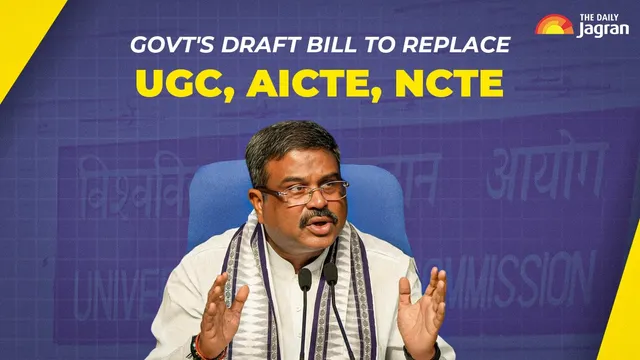
Higher Education Commission of India: The Government of India has taken a significant step towards redefining the country’s higher education landscape by drafting a bill to establish the Higher Education Commission of India (HECI). Announced in the Lok Sabha, this initiative seeks to unify three key regulatory bodies: the University Grants Commission (UGC), the All India Council for Technical Education (AICTE), and the National Council for Teacher Education (NCTE).
Driven by the transformative vision of the National Education Policy (NEP) 2020, HECI aims for what officials describe as a ‘light but tight’ regulatory structure designed to foster transparency, integrity, and resource optimisation.
NEP 2020’s Vision: Autonomy and Accountability:
According to Union Minister of State for Education Sukanta Majumdar, the bill envisions HECI as an umbrella body, with independent verticals handling regulation, funding, accreditation, and standard setting. This separation of functions seeks to combat the overlaps and bottlenecks that have long hampered India’s rapidly growing higher education sector.
NEP 2020 emphasises empowerment, autonomy, and out-of-the-box thinking, all while upholding strict governance and public accountability. The Ministry hopes to create an environment that encourages both innovation and efficiency.
What Will Change for Students and Institutions?
Currently, the UGC regulates non-technical education, AICTE oversees technical courses, and NCTE is responsible for teacher training standards. Unifying these into HECI is expected to reduce regulatory confusion, ensure clear accountability, and streamline processes for universities and colleges. The single-window approach proposed for the new body might also speed up essential decisions, accreditations, and funding allocations—issues that previously faced administrative delays.
A History of Attempts and Renewed Efforts:
The HECI concept is not entirely new. A similar draft bill surfaced in 2018, seeking public input, but did not come to fruition. The proposal gained renewed momentum after July 2021, following Dharmendra Pradhan’s appointment as Union Education Minister. Times of India notes that the NEP 2020 has repeatedly called for an overhaul of the regulatory system to help the sector thrive.
Concerns and Debates on Centralisation
While supporters applaud the plan for its promise of efficiency and clarity, critics question the risks of over-centralisation. They warn that it may stifle the autonomy of institutions and leave little room for nuanced decision-making in a sector as diverse as higher education. The government has assured that HECI will encourage autonomy as well as enforce high standards through transparent, evidence-based audits and disclosures.
Next Steps and the Road Ahead:
As the Ministry finalises the HECI bill, consultations continue with stakeholders to address concerns and refine the framework. This landmark reform, if passed, could redefine India’s higher education for decades, impacting millions of students and educators alike.
Fact Box:
The HECI was first proposed as a replacement for UGC in 2018, but progress stalled until recently.
NEP 2020 mandates the separation of functions—regulation, accreditation, funding, and standards—each to be handled independently within HECI.
If enacted, HECI would be one of India’s most ambitious higher education reforms, affecting over 1,000 universities and 40,000 colleges.