
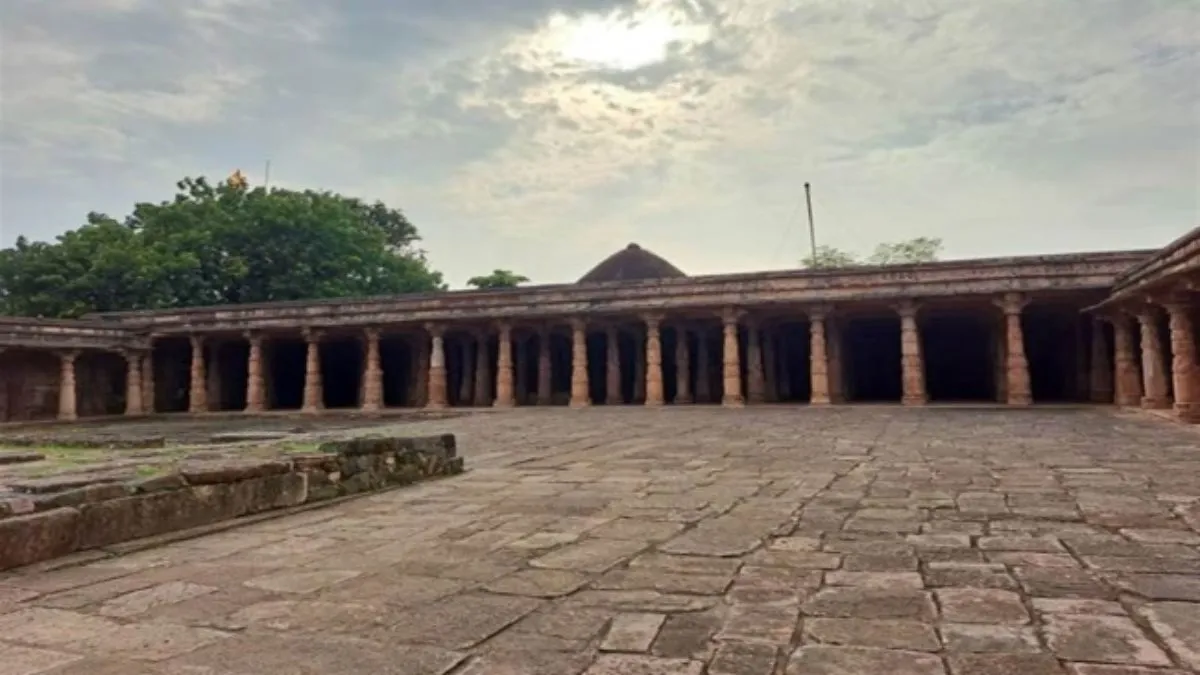
Bhojshala, located in the Dhar district of Madhya Pradesh, is once again in the headlines. On Friday, regarding Saraswati Puja at Bhojshala on the occasion of Vasant Panchami, the Supreme Court delivered a verdict stating that Hindus will be allowed to perform worship from morning until 12:00 pm. Following this, the Muslim side will offer Namaz. Hindus will then be able to resume worship from 4:00 pm onwards.
This dispute typically arises when Vasant Panchami falls on a Friday. On one hand, the Hindu community wishes to perform worship throughout the day once a year, while on the other hand, the Muslim community wants to offer Namaz according to the established arrangement. On such occasions, maintaining law and order becomes a significant challenge for the Dhar district police and administration.
Indeed, Bhojshala is no ordinary historical building. It is a site where the echoes of knowledge, philosophy and Sanskrit scriptures were once heard; today, legal arguments, religious claims and administrative orders are seen clashing at the very same spot. Bhojshala has now become one of India's most sensitive and long-standing religious-historical disputes.
Recommended For You
History Linked To Raja Bhoj’s Tradition Of Knowledge
The history of Bhojshala dates back to the 11th century. Raja Bhoj, the majestic ruler of the Paramara dynasty, established Dhar as a major center of education and culture in 1034 AD. He founded the 'Saraswati Sadan' here, which later came to be known as Bhojshala. It was a residential Sanskrit university, comparable to ancient centers of learning like Nalanda and Taxila.
Raja Bhoj himself was a great scholar. He authored numerous treatises on grammar, medicine, architecture, warfare and philosophy. The idol of Goddess Saraswati (Vaghdevi) was consecrated in Bhojshala on the day of Vasant Panchami. For centuries, this site remained a center of learning and spiritual practice.
ALSO READ: Hajj 2026: Jharkhand Issues Strict Health Guidelines; Dialysis, Heart And Cancer Patients Barred
 (File Photo)
History Carve In Stone
Even today, inscriptions in Sanskrit and Prakrit languages are present on the pillars, walls and ceilings of Bhojshala. Rules of grammar, tense forms, excerpts related to Natyashastra (science of drama) and idols of deities can be seen here. According to experts, all these structures indicate an educational and religious complex.
Invasion And Changing Form
However, circumstances changed after Alauddin Khilji's invasion of the Malwa region in the 13th-14th centuries. The Hindu side claims that the original temple and university structure of Bhojshala were demolished to construct a mosque. In a later period, the Dargah of Sufi Saint Kamal Maula was built near the complex.
Conversely, the Muslim side maintains that this place has been used as the Kamal Maula Mosque for a long time and Namaz has been offered here continuously.
British Era And The Idol’s Journey To London
Over time, an idol of Goddess Vaghdevi was found during excavations near Bhojshala, which was sent to London in 1880. This statue is reported to be still present abroad. This fact strengthens the Hindu side's claim that this site was originally a temple and a center of learning.
ASI Control After Independence
After independence, Bhojshala was placed under the Archaeological Survey of India (ASI) in 1952. For a long time thereafter, religious activities were banned here. Gradually, demands from both communities increased and the dispute deepened.
ALSO READ: Republic Day 2026: Kashmir On High Alert; Bakshi Stadium Under 3-Tier Security Cordon
Tension Increased Since 1990s
The Bhojshala dispute came out in the open after 1995. Hindu organisations intensified demands to declare it a Saraswati temple, while the Muslim community emphasised their right to the mosque. Seeing the situation deteriorate, the administration decided to limit religious activities. Subsequently, Hindus were allowed to worship on Tuesdays and Muslims to offer Namaz on Fridays.
May 12, 1997: The administration banned the entry of common citizens into Bhojshala. Hindus were allowed to worship on Vasant Panchami, and Muslims were allowed to offer Namaz on Fridays from 1:00 pm to 3:00 pm. This ban lasted until July 31, 1997.
February 6, 1998: The Archaeology Department banned entry into Bhojshala until further orders.
2003: Permission to worship on Tuesdays was reinstated. Bhojshala was also opened for tourists. It was decided that Hindus would worship here on Tuesdays, and full-day worship was permitted on Vasant Panchami. Meanwhile, the Muslim side was granted approval to offer Namaz here on Fridays.
This arrangement is in force to this day, but the dispute arises when Vasant Panchami and Friday coincide.
 (File Photo)
New Beginning Of Legal Battle
On May 2, 2022, the 'Hindu Front for Justice' filed a petition in the Madhya Pradesh High Court. The petition demanded that:
- Bhojshala be declared a place of worship exclusively for Hindus.
- A scientific survey be conducted by the ASI.
- Excavation, photography and videography of the complex be carried out.
Major High Court Order
In March 2023, the High Court ordered the ASI to conduct a detailed survey of the Bhojshala complex. This included Ground Penetrating Radar (GPR), photography and videography in the presence of both parties. The Supreme Court also refused to stay this order.
ALSO READ: Gurugram: Tractor Plunges Into Open GMDA Drain Near Dwarka Expressway; Major Accident Averted
ASI Report And New Indications
Several important facts have emerged in the ASI report:
- A total of 94 statues and their remains were found.
- Figures of various deities including Ganesha, Brahma, Narasimha and Bhairava.
- Inscriptions in Sanskrit and Prakrit.
- Indications that some statues were deliberately damaged.
The report states that the existing structure appears to have been built using architectural remains of a prior temple-like structure.
Confluence of Faith, History And Politics
Today, Bhojshala is not just a religious site but has become a center of political and social discourse. This issue arises in every election, tension escalates on every Vasant Panchami and with every court order, both hopes and apprehensions are born.
The story of Bhojshala is essentially the story of India's complex heritage, where history, faith and law leave their respective marks on the same stone.